The Persian Empire: Every Dynasty, Size, Capitals and Fall
The Persian Empire explained: the Median, Achaemenid, Parthian, Sasanian, Safavid, Afsharid and Qajar states, how big they were, and whether Iran is Persia.
 Open the interactive map
What was the Persian Empire?
The Persian Empire is not one state but a name English speakers give to a series of empires centred on the Iranian plateau over some 2,500 years. Most often it means the Achaemenid Empire founded by Cyrus the Great in 550 BCE, but it is also used for the Parthian and Sasanian empires of antiquity and, more loosely, for the Safavid, Afsharid and Qajar states of the early modern era. What links them is not a single bloodline but a recurring idea of Iranian kingship, a shared heartland and, from the ninth century onward, the Persian language as a language of government and culture.
This guide gives the essentials for each major dynasty: dates, capitals and approximate size. CivStory also has a dedicated page for each dynasty, from the Achaemenids, Seleucids, Parthians and Sasanians to the Safavids, Afsharids and Zands, Qajars and Pahlavis, and long-form storylines that explore them in depth.
The Medes and the Achaemenids (c. 7th century–330 BCE)
The Medes, an Iranian people of the north-western plateau, built the first major Iranian power, with its capital at Ecbatana, modern Hamadan. Allied with Babylon, they sacked the Assyrian capital Nineveh in 612 BCE, bringing down the Assyrian Empire, and then extended their influence into Anatolia. How centralised the Median state was is debated, since almost all the evidence comes from Herodotus and from Assyrian and Babylonian records, and some historians prefer to speak of a confederation rather than an empire.
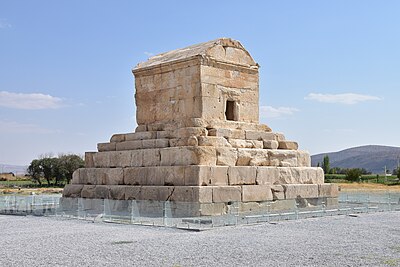
In 550 BCE Cyrus II, king of Anshan in Fars, overthrew the Median king Astyages and founded the Achaemenid Empire. Within two decades he had added Lydia and Babylon; Cambyses II took Egypt, and Darius I pushed the frontier to the Indus valley and into Thrace. The Achaemenids ruled from several capitals: Pasargadae, Susa, Persepolis, Ecbatana and Babylon. They governed through satraps, a royal road network and a policy of working with local elites and religions. The empire fell to Alexander of Macedon, who won at Gaugamela in 331 BCE; Darius III was killed by his own officers in 330 BCE.
The Parthians and the Sasanians (247 BCE–651 CE)
After a period of Macedonian Seleucid rule, the Parthians, or Arsacids, rose in the north-east around 247 BCE and by the late second century BCE ruled from Mesopotamia to the borders of modern Afghanistan. Their early royal centre was Nisa, near modern Ashgabat, and their main later capital was Ctesiphon on the Tigris. A decentralised empire of great noble houses, Parthia controlled key stretches of the Silk Roads and was Rome's most serious rival, famously defeating Crassus at Carrhae in 53 BCE. It lasted almost 470 years, longer than any other Iranian dynasty.
In 224 CE Ardashir I, from a family of Fars, defeated the last Parthian king and founded the Sasanian Empire. Ruling mainly from Ctesiphon, the Sasanians built a more centralised state, patronised Zoroastrianism as the religion of the court and fought Rome and Byzantium for four centuries; Shapur I even captured the emperor Valerian in 260 CE. Under Khosrow II in the 610s and 620s, Sasanian armies briefly held Syria, Jerusalem and Egypt. Exhausted by that war, the empire fell to the Arab Muslim conquests: after defeats at Qadisiyya and Nahavand, the last king, Yazdegerd III, was killed near Merv in 651.
Safavids, Afsharids and Qajars (1501–1925)
For more than eight centuries after 651, Iran was ruled by caliphs and by a succession of Iranian, Turkic and Mongol dynasties, from the Samanids and Buyids to the Seljuks, Ilkhanids and Timurids. These were often Persianate in culture, but they are not usually called the Persian Empire. That label returns with the Safavids, who in 1501 crowned Ismail I in Tabriz and reunited the plateau under one Iranian state. They made Twelver Shiism the state religion, moved the capital to Qazvin and then, under Shah Abbas I in 1598, to Isfahan. Their realm, roughly modern Iran plus the southern Caucasus, western Afghanistan and at times Iraq, effectively collapsed when Afghan forces took Isfahan in 1722.
Nader Shah of the Afshar tribe drove out the Afghans, crowned himself in 1736 and ruled from Mashhad, briefly building an empire that reached from the Caucasus to the Indus; in 1739 he defeated the Mughals and sacked Delhi. It fragmented after his assassination in 1747; the Zand dynasty then ruled much of Iran from Shiraz. Agha Mohammad Khan founded the Qajar dynasty, made Tehran the capital and was crowned in 1796. Under the Qajars, Iran lost its Caucasian provinces to Russia in the treaties of Golestan in 1813 and Turkmenchay in 1828, but also saw the Constitutional Revolution of 1905 to 1911. The Qajars were deposed in 1925, when Reza Khan became the first Pahlavi shah; the monarchy itself ended with the revolution of 1979.
How big was the Persian Empire?
At its height under Darius I, around 500 BCE, the Achaemenid Empire covered roughly 5.5 million square kilometres, stretching from Egypt and the Aegean to Central Asia and the Indus valley. That is more than three times the size of modern Iran, which covers about 1.65 million square kilometres, and made it the largest empire the world had yet seen. Population estimates vary widely, often between about 17 and 35 million people; popular claims that it ruled nearly half of humanity rest on very uncertain numbers and should be treated with caution.
Later Iranian empires were smaller but still vast. Rough modern estimates, such as those compiled by the political scientist Rein Taagepera, place the Parthian Empire at under 3 million square kilometres and the Sasanian Empire at about 3.5 million at its peak, with the Safavid state at roughly 3 million. All such figures depend on how loosely controlled frontier regions and tributaries are counted, so they are best read as orders of magnitude rather than precise measurements.
When did the Persian Empire fall?
Because there were several Persian empires, there are several answers. If you mean the Achaemenid Empire, it fell to Alexander between 334 and 330 BCE. If you mean the last great ancient Iranian empire, the Sasanian, it fell to the Arab conquests between 636 and 651 CE. Iranian statehood did not disappear in either case: the Parthians restored Iranian rule after the Seleucids, and Iranian administrators, language and court culture shaped the Abbasid caliphate and the dynasties that followed. If you mean Iranian monarchy as a whole, it ended in 1979, when the Islamic Revolution replaced the Pahlavi state with the Islamic Republic.
Is Iran the same as Persia?
Yes, in the sense that Persia is the traditional Western name for the country Iranians themselves have long called Iran. The word Persia comes, through Greek, from Parsa, the homeland of the Achaemenids, today's province of Fars. Iran comes from the ancient term for the land of the Aryans, the Iranians; the Sasanians already called their realm Eranshahr in the third century CE, and the name Iran runs through the Shahnameh and Persian literature. In 1935 the government of Reza Shah asked foreign governments to use Iran in official correspondence, and in 1959 the government of his son, Mohammad Reza Shah, confirmed that both names were acceptable.
The two words are not perfect synonyms, however. Iran is a multi-ethnic country where Persians live alongside Azerbaijanis, Kurds, Lurs, Baluch, Arabs, Turkmen and others, and Persian, or Farsi, is its official language and shared literary language. Persia evokes the history and culture of the plateau as seen from outside; Iran is the name of the country and of the wider cultural world its peoples built together.
Frequently asked questions
How big was the Persian Empire?
At its peak around 500 BCE, the Achaemenid Persian Empire covered roughly 5.5 million square kilometres, from Egypt and the Aegean to Central Asia and the Indus, more than three times the area of modern Iran.
When did the Persian Empire fall?
The Achaemenid Empire fell to Alexander the Great in 330 BCE. The Sasanian Empire, the last great ancient Iranian empire, fell to the Arab conquests in 651 CE. Iran's monarchy ended in 1979.
Is Iran Persia?
Yes. Persia is the historic Western name for Iran, derived from the province of Pars, or Fars. Iranians have called their land Iran since at least Sasanian times, and in 1935 the government asked other countries to use that name officially.
Who founded the Persian Empire?
Cyrus the Great founded the Achaemenid Persian Empire in 550 BCE after overthrowing the Median king Astyages. Before him, the Medes had built the first major Iranian state.
What was the capital of the Persian Empire?
It depends on the dynasty. The Achaemenids used Pasargadae, Susa, Persepolis, Ecbatana and Babylon; the Parthians and Sasanians mainly Ctesiphon; the Safavids Tabriz, Qazvin and Isfahan; Nader Shah Mashhad; and the Qajars Tehran.
Key events on the map
- 550 BCE · Founding of Achaemenid Empire
- 247 BCE · Rise of the Parthians
- 224 CE · Founding of Sasanian Empire
- 651 CE · Death of Yazdegerd III
- 1501 CE · Ismail I Crowns Himself Shah
- 1736 CE · Coronation of Nader Shah
- 1789 CE · Agha Mohammad Khan Founds the Qajar Dynasty
- 1935 CE · Persia Officially Renamed Iran
Guided storylines
- The Medes: Confederation, Kingdom, and Memory
- Cyrus the Great: From Anshan to Empire
- Darius: Governing an Empire
- Parthia: Empire and Compressed Memory
- The Sasanian Empire: Power, Religion, and Continuity
- Conquest and Continuity: Iran after the Sasanians
- The Safavid Transformation: State, Faith, and Empire
- Qajar Iran: War, Reform, and Constitutionalism
- ACHAEMENID DYNASTY — Encyclopaedia Iranica
- MEDIA — Encyclopaedia Iranica
- ARSACIDS ii. The Arsacid dynasty — Encyclopaedia Iranica
- SASANIAN DYNASTY — Encyclopaedia Iranica
- SAFAVID DYNASTY — Encyclopaedia Iranica
- QAJAR DYNASTY — Encyclopaedia Iranica
- IRAN i. LANDS OF IRAN — Encyclopaedia Iranica