Afsharid and Zand Dynasties: Nader Shah and Karim Khan (1736–1794)
The Afsharid and Zand dynasties: Nader Shah’s conquests from Delhi to Bukhara, then Karim Khan Zand’s calmer rule from Shiraz (1736–1794).
 Open the interactive map
Nader Shah and the Afsharid dynasty
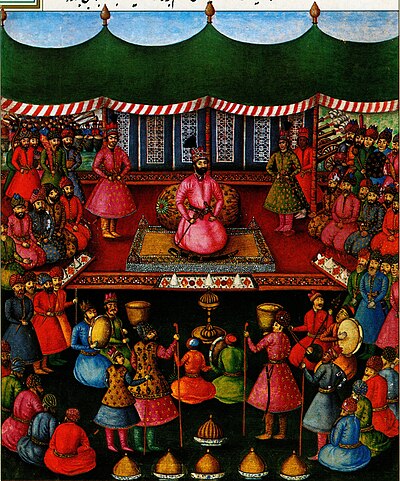
The Afsharid dynasty was founded by Nader, a commander from the Turkmen Afshar tribe of Khorasan who rose amid the chaos after the Afghan capture of Isfahan in 1722. Serving the Safavid claimant Tahmasp II, he drove the Afghans out of Iran in 1729, then deposed Tahmasp and, in 1736, had himself proclaimed shah at an assembly on the Moghan plain.
Nader was one of the most successful generals of his age. He took Kandahar in 1738, defeated the Mughal army at Karnal in 1739 and occupied Delhi, where a massacre followed an uprising against his troops; he returned with treasures including the Peacock Throne and the Koh-i-Noor diamond. He campaigned against Bukhara and Khiva and fought the Ottomans, while proposing that Twelver Shi‘ism be recognised as a fifth Sunni school, the Ja‘fari madhhab. His wars rested on crushing taxation, and his rule grew increasingly violent until his own officers assassinated him in 1747.
Karim Khan Zand and Shiraz
Nader’s empire fragmented quickly. His grandson Shahrokh held Khorasan, Ahmad Shah Durrani built an Afghan state in the east, and western Iran became a battleground for tribal chiefs. Karim Khan, leader of the Zand, a Lak tribe from the Zagros, emerged victorious by the 1760s. He never took the title of shah, ruling instead as vakil, deputy or regent, and later as vakil al-ra‘aya, often translated as advocate of the people. From his capital at Shiraz he built the Vakil Bazaar, mosque and bathhouse and the Arg citadel, and his forces captured Basra from the Ottomans in 1776.
Decline and legacy
After Karim Khan died in 1779, his relatives fought over the succession. The last Zand ruler, Lotf Ali Khan, was defeated by Agha Mohammad Khan Qajar and captured in 1794 near Bam. Nader is remembered as a military genius and a ruinous tyrant, while Karim Khan’s reputation as a just ruler owes something to later nostalgia; historians stress that his peace was relative and largely confined to the south and west.
Timeline of events
1729 CE · Nader Expels the Afghans
Nader Qoli, a brilliant military commander from Khorasan, defeats the Afghan Hotaki occupiers and liberates Isfahan, restoring nominal Safavid rule. (Isfahan) View on map
1736 CE · Coronation of Nader Shah
Nader Shah Afshar, called the 'Napoleon of Persia' and 'Second Alexander', deposes the last Safavid and crowns himself Shah on the Moghan Plain, founding the Afsharid dynasty. (Moghan Plain) View on map
1738 CE · Nader Shah Captures Kandahar
After a prolonged siege, Nader Shah captures the fortified city of Kandahar from Hussain Hotaki, ending the Hotaki dynasty and reunifying the eastern territories with Iran. Nader builds a new city nearby called Naderabad and uses Kandahar as a base for his subsequent invasion of the Mughal Empire. (Kandahar, Afghanistan) View on map
1739 CE · Nader Shah's Invasion of India
Nader Shah invades India and sacks Delhi, defeating the Mughal Empire at the Battle of Karnal. He seizes the Peacock Throne and the Koh-i-Noor diamond. (Delhi) View on map
1740 CE · Nader Shah's Central Asian Campaign
Nader Shah conquers the Khanates of Bukhara and Khiva in Central Asia, forcing their rulers to submit and bringing Transoxiana temporarily under Iranian control. These campaigns represent the last time an Iranian ruler controlled territories beyond the Oxus River, extending the Afsharid Empire to its greatest extent. (Bukhara, Uzbekistan) View on map
1743 CE · Nader Shah Defeats the Ottomans
Nader Shah decisively defeats the Ottoman Empire in multiple campaigns, recapturing all territories lost to the Ottomans and forcing them to cede lands in the Caucasus and Mesopotamia. (Mosul) View on map
1747 CE · Assassination of Nader Shah
Nader Shah, who had become increasingly tyrannical and paranoid, is assassinated by his own officers. His vast empire rapidly disintegrates. (Khabushān (near Quchan), Khorasan) View on map
1751 CE · Karim Khan Zand: Advocate of the People
Karim Khan Zand establishes the Zand dynasty, refusing the title 'Shah' and calling himself 'Vakil al-Ra'aya' (Advocate of the People). He brings peace and prosperity to Iran. (Shiraz) View on map
1762 CE · Shiraz: Zand Capital and Cultural Center
Karim Khan makes Shiraz the capital and beautifies it with magnificent buildings including the Arg of Karim Khan citadel, Vakil Bazaar, and Vakil Mosque. (Shiraz) View on map
1776 CE · Zand Capture of Basra
Karim Khan Zand captures Basra from the Ottoman Empire, temporarily extending Zand control to the Persian Gulf trade port. (Basra) View on map
1779 CE · Death of Karim Khan Zand
Karim Khan dies peacefully in Shiraz. His death triggers a destructive power struggle among Zand princes, eventually leading to Qajar dominance. (Shiraz) View on map
1794 CE · Lotf Ali Khan: Last Zand King
Lotf Ali Khan, the brave young last Zand king, fights heroically against the Qajar forces of Agha Mohammad Khan before being captured and brutally killed. (Bam / Kerman) View on map
Frequently asked questions
Why is Nader Shah called the Napoleon of Persia?
The nickname, popularised by European writers, reflects his rise from modest origins to rule through military brilliance and his campaigns across India, Central Asia and the Ottoman frontier. It is a comparison, not a historical title.
Why did Karim Khan Zand not call himself shah?
He initially ruled in the name of a Safavid prince, Ismail III, and kept the title vakil even after that figurehead faded. The choice reflected political caution about legitimacy in a land still attached to the Safavid name, though his exact motives are not recorded.
Key events on the map
- 1736 CE · Coronation of Nader Shah
- 1739 CE · Nader Shah's Invasion of India
- 1751 CE · Karim Khan Zand: Advocate of the People
- 1762 CE · Shiraz: Zand Capital and Cultural Center
- Afsharids — Encyclopaedia Iranica
- Nāder Shah — Encyclopaedia Iranica
- Zand Dynasty — Encyclopaedia Iranica
- Karim Khan Zand — Encyclopaedia Iranica