Sasanian Empire: History, Timeline & Map
Sasanian Empire history (224–651 CE): Ardashir, Shapur I and Valerian, Khosrow Anushirvan, the wars with Rome and the Arab conquest, mapped by year.
 Open the interactive map
What was the Sasanian Empire?
The Sasanian Empire (224–651 CE) was the last great Iranian empire before Islam. Its kings came from a family linked to the temple of Anahid at Istakhr in Pars, called their realm Eranshahr, "the land of the Iranians", and for more than four centuries ruled from Mesopotamia to Central Asia as the chief rival of Rome and then Byzantium.
Rise of the Sasanians: Ardashir and Shapur I
Ardashir I defeated the last Parthian king, Artabanus IV, in 224 CE and was soon crowned at Ctesiphon. His son Shapur I (r. c. 240–270) fought three Roman emperors with striking success: Gordian III died during his campaign against Persia in 244 (the circumstances are disputed), Philip the Arab paid for peace, and Valerian was captured near Edessa in 260. Shapur's trilingual inscription at the Ka'ba-ye Zartosht, Naqsh-e Rostam, gives the Persian version of these events, which Roman writers tell very differently.
State, Religion and Culture
Sasanian kings built a more centralised state than the Parthians, alongside a powerful Zoroastrian priesthood; the high priest Kardir promoted a state-backed orthodoxy in the late third century. Yet the empire also held large Christian, Jewish and Manichaean communities: the Babylonian Talmud and the Church of the East both took shape under Sasanian rule.
Khosrow I Anushirvan (531–579) reformed taxation and the army and patronised learning, including translations from Greek and Sanskrit. Silver vessels, silk textiles, rock reliefs and the great vaulted hall of Ctesiphon (Taq Kasra) carried Sasanian style from China to Europe.
Decline, Arab Conquest and Legacy
The war of 602–628 between Khosrow II and Byzantium first carried Persian armies to Jerusalem (614) and Egypt, then ended with Heraclius's counteroffensive and Khosrow's overthrow. Years of civil war followed, including the brief reigns of the queens Boran and Azarmidokht. The exhausted empire was defeated by Arab Muslim armies at al-Qadisiyyah (c. 636) and Nahavand (642), and Yazdegerd III was killed near Merv in 651. Sasanian administration, court culture and the Middle Persian "Book of Kings" tradition lived on in the Abbasid caliphate and in Ferdowsi's Shahnameh.
Timeline of events
224 CE · Founding of Sasanian Empire
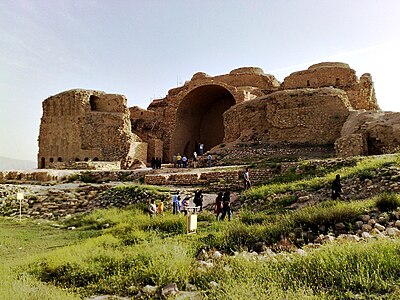
Ardashir I defeats the last Parthian king Artabanus V at the Battle of Hormozdgan, establishing the Sasanian dynasty — the last great pre-Islamic Persian empire. (Firuzabad) View on map
226 CE · Ctesiphon as Sasanian Capital
Ardashir I establishes Ctesiphon as the Sasanian capital. The grand Taq Kasra (Arch of Ctesiphon), the largest single-span vault of the ancient world, was later built under Khosrow I Anushirvan in the 6th century CE. (Ctesiphon) View on map
240 CE · Reign of Shapur I
Shapur I expands the empire, defeats three Roman emperors, and promotes tolerance of Christianity, Manichaeism, and Judaism alongside Zoroastrianism. (Bishapur) View on map
240 CE · Mani Founds Manichaeism
The prophet Mani, born in Sassanid Mesopotamia to an Iranian family, founds Manichaeism — a dualistic religion synthesizing Zoroastrian, Christian, and Buddhist elements. It spreads from Rome to China, becoming one of the most geographically widespread religions in history before its eventual suppression. (Ctesiphon, Iraq) View on map
260 CE · Shapur I Captures Roman Emperor Valerian
Shapur I defeats and captures Roman Emperor Valerian at the Battle of Edessa — the only time a Roman emperor was captured in battle. This triumph is carved at Naqsh-e Rostam. (Edessa (Urfa)) View on map
260 CE · Shushtar Historical Hydraulic System
Construction of the massive Shushtar hydraulic system including dams, canals, and water mills — a masterpiece of Sasanian engineering using Roman prisoners of war. (Shushtar) View on map
271 CE · Academy of Gundishapur
Founded under Shapur I, the Academy of Gundishapur grew over centuries into a major intellectual center for medicine, philosophy, and science. By the 5th–6th century, it was arguably the world's first teaching hospital and research institution, drawing scholars from Greece, India, and Syria. (Gundishapur) View on map
280 CE · Kartir Establishes Zoroastrian Orthodoxy
High priest Kartir consolidates Zoroastrianism as the state religion, compiling the Avesta and persecuting rival religions including Manichaeism. (Naqsh-e Rajab) View on map
309 CE · Reign of Shapur II the Great
Shapur II rules for 70 years (the longest in Sasanian history), defeats the Romans, recaptures lost territories, and strengthens the eastern borders against the Kushans. (Ctesiphon) View on map
350 CE · Compilation of the Avesta
The Sasanian state sponsors the systematic compilation and canonization of the Avesta, the holy book of Zoroastrianism, preserving ancient oral traditions. (Ctesiphon) View on map
363 CE · Death of Emperor Julian in Persia
Roman Emperor Julian invades Sasanian territory but is killed in battle. His successor Jovian signs a humiliating peace ceding five provinces to Persia. (Maranga (near Samarra)) View on map
363 CE · Treaty of 363 with Rome
After Emperor Julian's death during his invasion of Persia, his successor Jovian signs a humiliating peace treaty with Shapur II. Rome cedes five provinces east of the Tigris, the strategically vital fortress of Nisibis, and agrees not to aid Armenia — the most favorable treaty the Sasanians ever achieved against Rome. (Nisibis (Nusaybin, Turkey)) View on map
400 CE · Sasanian Silk and Textile Arts
Sasanian silk textiles with their distinctive roundel designs depicting royal hunts, mythical creatures, and geometric patterns become prized luxury goods across Eurasia. (Ctesiphon and across the empire) View on map
400 CE · Sogdian Merchants: Masters of the Silk Road
Sogdian merchants from the Iranian cultural sphere dominate Silk Road trade for centuries, establishing trading colonies from China to Byzantium. Their language becomes the lingua franca of Central Asian commerce, spreading Zoroastrian, Manichaean, and Buddhist ideas across the continent. (Samarkand) View on map
420 CE · Bahram V (Bahram Gur)
Bahram V, known as Bahram Gur, becomes one of the most celebrated Sasanian kings in Persian literature, famous for his hunting exploits and romances celebrated in Shahnameh. (Ctesiphon) View on map
450 CE · Persian Caravanserai Tradition
The Sasanian Empire systematizes the network of caravanserais (roadside inns) along trade routes, providing shelter, food, and security for merchants. This tradition, rooted in Achaemenid royal road stations, will continue for over a millennium — Iran alone has over 1,000 historic caravanserais. (Isfahan region) View on map
494 CE · Mazdak's Social Revolution
Mazdak preaches radical social equality, communal property, and vegetarianism. Initially supported by King Kavad I, the movement is later violently suppressed. (Ctesiphon) View on map
531 CE · Reign of Khosrow I Anushirvan
Khosrow I 'Anushirvan' (the Immortal Soul) presides over the golden age of Sasanian civilization with major reforms in taxation, military, and administration. He patronizes art, science, and philosophy. (Ctesiphon) View on map
540 CE · Administrative Reforms of Khosrow I
Khosrow I implements sweeping reforms: fixed land taxation, professional standing army (instead of feudal levies), and division of the empire into four military districts. (Ctesiphon) View on map
550 CE · Chess (Chatrang) Comes to Persia
The Indian game of Chaturanga is introduced to Sasanian Persia, where it evolves into Chatrang (Shatranj), later spreading to the Arab world and Europe. (Ctesiphon) View on map
550 CE · Borzuya Brings Indian Knowledge to Persia
The physician Borzuya travels to India on Khosrow I's orders, bringing back the Panchatantra tales (later Kalila wa Dimna) and Indian medical knowledge. (Gundishapur) View on map
590 CE · Reign of Khosrow II Parviz
Khosrow II's reign sees Sasanian expansion to its greatest territorial extent, conquering Egypt, Jerusalem, and Anatolia from Byzantium, before ultimate defeat. (Ctesiphon) View on map
590 CE · Taq-e Bostan Rock Reliefs
The magnificent rock reliefs at Taq-e Bostan near Kermanshah depict Sasanian kings in hunting and investiture scenes, showcasing the height of Sasanian art. (Taq-e Bostan, Kermanshah) View on map
614 CE · Sasanian Conquest of Jerusalem
Sasanian general Shahrbaraz captures Jerusalem, taking the True Cross relic. The Sasanian Empire briefly stretches from Egypt to Central Asia. (Jerusalem) View on map
627 CE · Byzantine Counter-offensive under Heraclius
Byzantine Emperor Heraclius launches a devastating counter-offensive deep into Sasanian territory, sacking the royal palace at Dastagird and recovering the True Cross. (Dastagird) View on map
630 CE · Queen Boran (Purandokht): Sasanian Ruler
Boran, remembered in later Persian sources as Purandokht, was a daughter of Khosrow II. She took the throne in 630 amid the civil wars that followed her father's fall, one of the very few women to rule the Sasanian Empire in her own right. She struck coins in her own name and sought peace with Byzantium, and Islamic-era chroniclers credit her with lowering taxes and repairing the realm. Her short reign, broken by rival claimants, ended around 632 and could not halt the empire's collapse. (Ctesiphon) View on map
632 CE · Yazdegerd III: Last Sasanian King
Yazdegerd III ascends the throne of a weakened empire ravaged by civil war and plague. He spends his reign fleeing the Arab conquests. (Ctesiphon) View on map
636 CE · Battle of al-Qadisiyyah
The decisive battle where Muslim Arab armies under Sa'd ibn Abi Waqqas defeat the Sasanian army under Rostam Farrokhzad, opening Iran to the Arab conquest. (Al-Qadisiyyah) View on map
642 CE · Battle of Nahavand
Called the 'Victory of Victories' by Arab historians, this battle effectively ends organized Sasanian resistance and opens the Iranian heartland to Arab conquest. (Nahavand) View on map
651 CE · Death of Yazdegerd III
Yazdegerd III is murdered near Merv by a local miller, ending the Sasanian dynasty after over 400 years of rule. (Merv) View on map
Frequently asked questions
How did the Sasanian Empire fall?
A long war with Byzantium (602–628) and the civil wars that followed left the empire exhausted and divided. Arab Muslim armies then won decisive battles at al-Qadisiyyah (c. 636) and Nahavand (642), and the last king, Yazdegerd III, was killed near Merv in 651. Resistance in parts of Iran continued for decades.
Who captured the Roman emperor Valerian?
Shapur I captured Valerian near Edessa in 260 CE. The event is celebrated in Shapur's inscription and rock reliefs at Naqsh-e Rostam. Valerian died in captivity; lurid stories about his humiliation come mainly from later Roman Christian writers and should be treated with caution.
Key events on the map
- 224 CE · Founding of Sasanian Empire
- 260 CE · Shapur I Captures Roman Emperor Valerian
- 531 CE · Reign of Khosrow I Anushirvan
- 642 CE · Battle of Nahavand
Guided storylines
- Sasanian Dynasty — Encyclopaedia Iranica
- Sasanians — Livius.org
- Sasanian Empire — World History Encyclopedia