Achaemenid Empire: History, Timeline & Map
Achaemenid Empire history (550–330 BCE): Cyrus, Darius, Persepolis, the satrapies and the fall to Alexander, on an interactive timeline and map.
 Open the interactive map
What was the Achaemenid Empire?
The Achaemenid Empire (c. 550–330 BCE) was the first Persian empire and, at its height under Darius I, the largest state the world had yet seen, stretching from the Indus valley and Central Asia to Egypt, Anatolia and the shores of the Aegean. Its rulers came from Pars (modern Fars) in southwestern Iran and styled themselves "king of kings", governing dozens of peoples who kept their own languages, gods and local elites.
Rise of the Persian Empire: From Cyrus to Darius
Cyrus II, king of Anshan, overthrew the Median king Astyages around 550 BCE, then conquered Lydia (c. 546) and Babylon (539). His son Cambyses II added Egypt in 525. After a disputed succession in 522, Darius I seized the throne. His own account, carved at Behistun in Old Persian, Elamite and Babylonian, is our main source for these events, but it was written to justify his kingship and should be read as royal argument rather than neutral record.
Government, Persepolis and Daily Life
Darius organised the empire into satrapies paying regular tribute, introduced the gold daric, extended royal roads linking Sardis to Susa, and began building Persepolis around 518 BCE. Thousands of clay tablets from Persepolis record rations of grain, wine and beer for workers, including women, giving a bureaucratic view of daily life that Greek authors never offer. Aramaic served as a common language of administration.
Royal inscriptions present the king as chosen by Ahuramazda and as the guardian of order against "the Lie". Achaemenid religious policy was broadly accommodating, but calling the Cyrus Cylinder the "first charter of human rights" is a modern interpretation, not its original purpose.
Wars with Greece, Fall and Legacy
Persian expeditions against Greece in 490 and 480–479 BCE failed, but for the Persian court they were campaigns on a distant western frontier of an empire centred on Iran and Mesopotamia. Most accounts come from Greek writers such as Herodotus, whose army figures are not reliable. The empire remained powerful for another century and a half, often shaping Greek politics through diplomacy and gold.
Alexander of Macedon defeated Darius III at Gaugamela in 331 BCE, and Persepolis burned in 330. The Achaemenid model of a multi-ethnic empire ruled through local elites influenced the Seleucids, Parthians and Sasanians, and it remains central to Iranian historical memory.
Timeline of events
675 BCE · Kingdom of Anshan: Cradle of the Achaemenids
Teispes of the Achaemenid line rules Anshan (in modern Fars province), establishing the Persian kingdom that will become the Achaemenid Empire. His descendants — Cyrus I, Cambyses I — build toward Cyrus the Great. (Anshan (near Persepolis)) View on map
550 BCE · Founding of Achaemenid Empire
Cyrus the Great defeats Astyages of Media and establishes the Achaemenid Empire, the first Persian Empire. (Pasargadae) View on map
550 BCE · Development of Qanat Irrigation System
Persians refine and spread the qanat (underground aqueduct) system across the empire, a revolutionary water management technology with origins on the Iranian plateau possibly dating to 1000 BCE or earlier, still in use today. (Iranian Plateau) View on map
546 BCE · Conquest of Lydia
Cyrus the Great defeats King Croesus and conquers the wealthy Lydian kingdom, gaining control of Asia Minor and its Greek coastal cities. (Sardis) View on map
539 BCE · Cyrus Enters Babylon
Cyrus the Great conquers Babylon, issuing the Cyrus Cylinder — a declaration of religious tolerance that allowed conquered peoples to worship their own gods and maintain their customs. (Babylon) View on map
538 BCE · Cyrus Frees the Jews from Babylonian Captivity
Cyrus allows the Jewish exiles in Babylon to return to Jerusalem and rebuild their Temple, earning him the title 'Messiah' in the Hebrew Bible. (Jerusalem) View on map
530 BCE · Death of Cyrus the Great
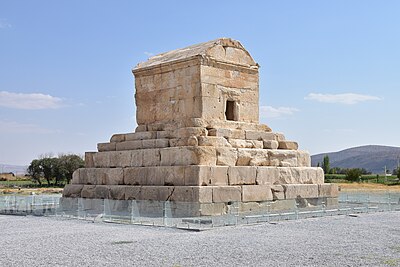
Cyrus the Great dies in battle against the Massagetae on the eastern frontier. He is buried in his tomb at Pasargadae. (Eastern frontier (Central Asia)) View on map
525 BCE · Cambyses II Conquers Egypt
Cambyses II, son of Cyrus, conquers Egypt at the Battle of Pelusium, adding it to the Persian Empire and becoming Pharaoh. (Pelusium, Egypt) View on map
522 BCE · Darius I Seizes Power
Darius I overthrows Gaumata (or the legitimate Bardiya — accounts differ) and establishes himself as king, recording his version of events on the Behistun Inscription. Whether Bardiya was an impostor or the rightful heir remains one of the great debates of Achaemenid history. (Behistun) View on map
520 BCE · Behistun Inscription
Darius I carves the monumental Behistun Inscription in three languages (Old Persian, Elamite, Babylonian), key to deciphering cuneiform. (Behistun) View on map
520 BCE · Establishment of the Satrap System
Darius I organizes the empire into 20-36 satrapies (provinces), each governed by a satrap, creating an efficient administrative system for the vast empire. (Susa) View on map
518 BCE · Construction of Persepolis Begins
Darius I begins construction of the ceremonial capital Persepolis (Parsa), a masterpiece of Achaemenid architecture showcasing the empire's grandeur. (Persepolis) View on map
515 BCE · Construction of the Royal Road
Darius I builds the Royal Road stretching 2,700 km from Susa to Sardis, with postal relay stations enabling rapid communication across the empire. (Susa to Sardis) View on map
513 BCE · Darius' Campaign Against Scythians
Darius I crosses the Bosphorus and Danube to campaign against the Scythians in the steppes north of the Black Sea, but fails to defeat them decisively. (Scythian Steppes) View on map
510 BCE · Introduction of the Daric Coinage
Darius I standardizes the imperial currency with the gold Daric and silver Siglos, creating one of the first unified monetary systems. (Susa) View on map
510 BCE · Palace of Darius at Susa
Darius I builds the magnificent palace complex at Susa using materials and craftsmen from across the empire, as documented in the Susa Foundation Charter. (Susa) View on map
500 BCE · Darius I Completes Suez Canal
Darius I completes a canal connecting the Nile to the Red Sea, an ancient precursor of the modern Suez Canal, facilitating trade across the empire. (Suez region, Egypt) View on map
500 BCE · Persian Garden Tradition (Pairidaeza)
The Persian concept of 'pairidaeza' (walled garden/paradise) spreads across the empire and into Greek vocabulary as 'paradeisos', becoming the origin of the word 'paradise'. (Pasargadae) View on map
499 BCE · Ionian Revolt
Greek cities in Ionia revolt against Persian rule with Athenian support. The revolt's suppression leads to the Greco-Persian Wars. (Miletus, Ionia) View on map
490 BCE · Battle of Marathon
First Persian invasion of Greece ends in defeat for Darius I's forces against the Athenians at the plain of Marathon. (Marathon, Greece) View on map
490 BCE · Naqsh-e Rostam Royal Tombs
The rock-cut tombs of Darius I, Xerxes I, Artaxerxes I, and Darius II are carved into the cliffside at Naqsh-e Rostam near Persepolis. (Naqsh-e Rostam) View on map
480 BCE · Xerxes' Invasion of Greece
Xerxes I leads a massive army and navy to invade Greece. After victory at Thermopylae and sacking Athens, the campaign ultimately fails at Salamis and Plataea. (Thermopylae, Greece) View on map
480 BCE · Battle of Thermopylae
300 Spartans and allied Greeks make their famous last stand against Xerxes' vast army at the narrow pass of Thermopylae. (Thermopylae) View on map
480 BCE · Battle of Salamis
Greek navy, led by Themistocles, decisively defeats the Persian fleet in the straits of Salamis, turning the tide of the Greco-Persian Wars. (Salamis, Greece) View on map
449 BCE · Peace of Callias
Treaty between Artaxerxes I and the Delian League is said to have ended the Greco-Persian Wars, establishing spheres of influence between Persia and Greece. Some modern historians, however, question whether this treaty was ever formally concluded. (Susa) View on map
440 BCE · Herodotus Writes the Histories
Herodotus of Halicarnassus, born a subject of the Achaemenid Empire, writes his Histories documenting the Greco-Persian Wars and Persian customs, earning the title 'Father of History'. (Halicarnassus (Bodrum)) View on map
404 BCE · Reign of Artaxerxes II
Longest-reigning Achaemenid king, known for the revolt of his brother Cyrus the Younger (Battle of Cunaxa) and the King's Peace with Greek city-states. (Susa) View on map
401 BCE · Battle of Cunaxa
Cyrus the Younger, with Greek mercenaries (the Ten Thousand), challenges Artaxerxes II for the throne but is killed in battle, inspiring Xenophon's Anabasis. (Cunaxa, near Babylon) View on map
331 BCE · Battle of Gaugamela
Alexander the Great decisively defeats Darius III at Gaugamela, effectively ending Achaemenid rule over the Persian Empire. (Gaugamela (near Mosul)) View on map
330 BCE · Burning of Persepolis
Alexander the Great conquers the Persian capital Persepolis and burns the magnificent palace complex, possibly in revenge for the burning of Athens. (Persepolis) View on map
330 BCE · Death of Darius III
Darius III, the last Achaemenid king, is murdered by his own satrap Bessus while fleeing Alexander. Alexander honors Darius with a royal funeral. (Near Damghan) View on map
Frequently asked questions
When did the Achaemenid Empire start and end?
It is usually dated from about 550 BCE, when Cyrus the Great defeated the Median king Astyages, to 330 BCE, when Darius III was killed after his defeat by Alexander of Macedon.
Who founded the Achaemenid Empire?
Cyrus II (Cyrus the Great) founded the empire. The dynasty is named after Achaemenes, an ancestor whose historical existence is uncertain; Darius I stressed descent from him, and how Cyrus's family related to that line is still debated.
How big was the Achaemenid Empire?
At its peak around 500 BCE it covered roughly 5.5 million square kilometres, from the Indus to Egypt and Thrace, though modern estimates vary because ancient borders were not fixed lines.
Key events on the map
- 550 BCE · Founding of Achaemenid Empire
- 539 BCE · Cyrus Enters Babylon
- 520 BCE · Behistun Inscription
- 518 BCE · Construction of Persepolis Begins
Guided storylines
- Achaemenid Dynasty — Encyclopaedia Iranica
- Achaemenids — Livius.org
- Achaemenid Empire — World History Encyclopedia