Conquest and Continuity: Iran after the Sasanians
The seventh-century conquest ended Sasanian rule but began a long, uneven transformation rather than an instant cultural replacement. Iranian languages, communities, and institutions adapted within successive Islamic empires, alongside profound religious and political change.
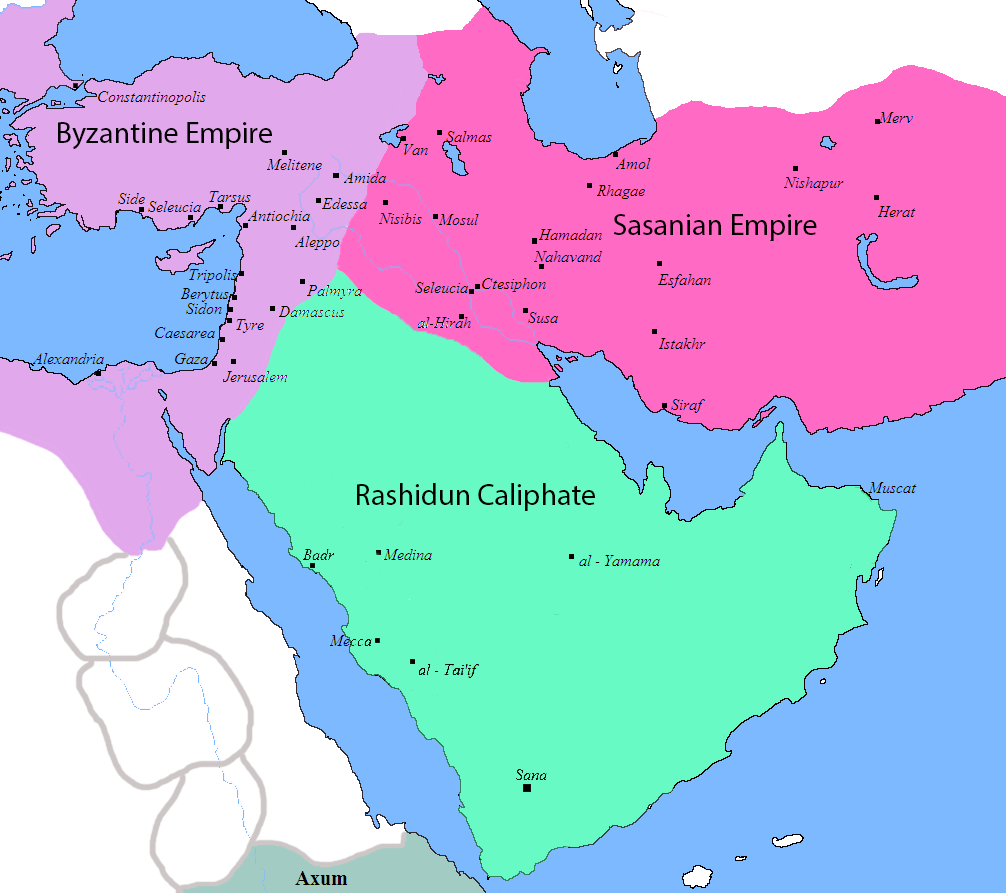 Start this guided tour on the map
Part 1
The Sasanian Empire ruled Iran and neighboring lands from 224 until 651, a major but not uniquely long Iranian dynasty. Decades of war with Byzantium, political conflict, and fiscal strain weakened the state before Arab-Muslim armies advanced. The conquest ended Sasanian imperial rule, not Iranian society or all of its institutions.
- ʿArab ii. Arab Conquest of Iran — Encyclopaedia Iranica
Part 2
Arab-Muslim victories at Qadisiyya and Nihavand opened much of the Sasanian realm to conquest, but control was uneven and resistance continued in several regions. Yazdegerd III moved east before his death in 651. Treating one battle as the instant collapse of a civilization hides a prolonged and locally varied transition.
- ʿArab ii. Arab Conquest of Iran — Encyclopaedia Iranica
Part 3
Conversion to Islam unfolded over centuries rather than immediately after conquest. Arabic became central to religion, imperial administration, and much scholarship, while Middle Persian and other Iranian languages continued and changed. New Persian later emerged in Arabic script within this multilingual environment.
- ʿArab ii. Arab Conquest of Iran — Encyclopaedia Iranica
- Persian Language i. Early New Persian — Encyclopaedia Iranica
Part 4
Zoroastrian communities remained in Iran, while groups that became the Parsis settled in western India. Their migration narrative is known chiefly from the much later Qissa-ye Sanjan, so the route and chronology cannot be recovered with certainty. Community memory and historical reconstruction should therefore be distinguished.
- Parsi Communities i. Early History — Encyclopaedia Iranica
Part 5
The Abbasid movement grew in Khurasan from grievances shared by varied Arab and non-Arab constituencies. Iranian converts and commanders were important, but the coalition cannot be reduced to an ethnic national revolt. Its victory in 750 replaced one caliphal dynasty with another and redistributed power within an Islamic empire.
- ʿAbbasid Caliphate — Encyclopaedia Iranica
Part 6
Under the Abbasids, people from Iranian lands held prominent military, secretarial, and courtly roles while Arabic remained the principal language of the caliphate. Encyclopaedia Iranica traces dīvān as a Middle Persian term borrowed into Arabic and documents its changing administrative uses, while noting debate over its deeper origin. That history shows institutional exchange without making the caliphate the possession of one people.
- Dīvān i. The Term — Encyclopaedia Iranica
Part 7
Baghdad became a major center of administration, commerce, literature, and science under the Abbasids. Scholars and officials from many regions worked chiefly in Arabic while drawing on Greek, Syriac, Persian, Indian, and other traditions. This was a collaborative Islamicate world, not knowledge belonging exclusively to one ethnicity or religion.
- Baghdad — Encyclopaedia Iranica
- Bayt al-Hikmah — Encyclopaedia Britannica