Persepolis: History of the Achaemenid Royal City
Persepolis history explained: who built it, what the Apadana and Gate of All Nations were for, who worked there, and why Alexander burned it in 330 BCE.
 Open the interactive map
What was Persepolis?
Persepolis was the great royal city of the Achaemenid Persian Empire, built on a vast stone terrace at the foot of Kuh-e Rahmat, the Mountain of Mercy, in the Marvdasht plain about 60 kilometres north-east of modern Shiraz. Its builders called it Parsa, the same name as their homeland, the province known today as Fars. Persepolis, meaning city of the Persians, is the later Greek name; Iranians have long called the ruins Takht-e Jamshid, the Throne of Jamshid, after the legendary king of the Shahnameh.
The history of Persepolis spans less than two centuries, from about 518 BCE, when Darius I began the terrace, to its burning by Alexander of Macedon in 330 BCE. In that time it became the most ambitious expression of Achaemenid kingship, and since 1979 it has been a UNESCO World Heritage Site.
Who built Persepolis, and how?
Darius I chose the site and levelled a platform roughly 450 by 300 metres, partly cut from the mountain and partly built up with fitted blocks. He started the Apadana, the great audience hall, and his own palace, the Tachara. His son Xerxes I finished the Apadana, added the Gate of All Nations and his own palace, the Hadish, and began the Hall of a Hundred Columns, which Artaxerxes I completed. Later kings kept adding buildings, so Persepolis was always a work in progress.
The construction drew on the whole empire. A foundation text in which Darius describes building his palace at Susa lists cedar from Lebanon, gold from Sardis and Bactria, and craftsmen from Ionia, Egypt, Babylon and Media, and the mixed artistic language of Persepolis reflects the same empire-wide effort. Assyrian, Egyptian and Greek elements were combined into a style that is unmistakably Persian: tall slender columns topped by double-headed bulls, griffins or lions, and wide halls designed to impress visitors.
The Apadana and the Gate of All Nations
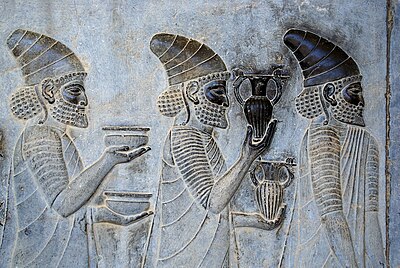
The Apadana is the best-known building at Persepolis. Its roof rested on seventy-two columns about 20 metres high, of which only a few still stand. Its stairways carry the site's most famous reliefs: rows of Persian and Median nobles and guards, and delegations from more than twenty peoples of the empire, among them Lydians, Babylonians, Egyptians, Arabs, Bactrians, Scythians and Indians, each bringing characteristic gifts such as horses, textiles, vessels and animals.
Visitors climbed a broad double staircase with shallow steps and entered through the Gate of All Nations, guarded by colossal winged bulls and inscribed by Xerxes in Old Persian, Elamite and Babylonian. The message of the whole complex was harmony under the king. Unlike Assyrian palace reliefs, which often show sieges and slaughter, Persepolis shows almost no violence: subject peoples appear orderly and dignified, an image of empire as a cooperative order, however idealised that picture may have been.
Who worked at Persepolis? Evidence from the tablets
In 1933 and 1934, archaeologists from the University of Chicago's Oriental Institute found tens of thousands of clay tablets and fragments in the fortification wall of the terrace. Written mostly in Elamite and dating to about 509–493 BCE, these Persepolis Fortification Tablets are administrative records of food rations, livestock, travel and labour across the region. A smaller group, the Treasury Tablets, records payments to workers in the following decades.
The tablets show a large, organised workforce of men, women and children, often grouped by origin, receiving rations of grain, wine and beer, with extra allowances for skilled craftsmen and for women who had recently given birth. They are often cited to show that Persepolis was not built by slaves, and they do disprove the image of a chain gang. Historians still debate the legal status of these workers, called kurtash, some of whom may have been deportees, so the most accurate statement is that they were paid, registered labourers within a state system.
What was Persepolis used for?
Persepolis was not the empire's only capital. The court moved between Susa, Babylon, Ecbatana and Persepolis with the seasons, and Pasargadae, Cyrus's earlier foundation, lay about 40 kilometres to the north. Persepolis was the dynastic heart in the Persian homeland, a treasury, an administrative centre and a stage for royal ceremony. Darius, Xerxes and later kings were buried in rock-cut tombs nearby at Naqsh-e Rostam, and the last Achaemenid kings had tombs cut into the mountain behind the terrace.
A popular modern idea holds that Persepolis was built for Nowruz celebrations, with the Apadana reliefs showing the New Year procession. It is an attractive theory, but there is no ancient text that says so, and many historians prefer to see the reliefs as a timeless image of the empire rather than a record of a specific festival.
Why did Alexander burn Persepolis?
After defeating Darius III at Gaugamela in 331 BCE, Alexander reached Persepolis early in 330 BCE, plundered its treasury, which ancient writers say needed thousands of pack animals to carry, and some months later set the palaces on fire. Archaeologists have found the burned layers, especially in the Hall of a Hundred Columns and the treasury. Ancient accounts disagree on why: some present it as calculated revenge for the Persian burning of the Athenian Acropolis in 480 BCE, others as a drunken act urged on by the courtesan Thais. Both stories come from Greek and Roman writers centuries later, and modern historians often read the fire as a deliberate political signal that the Achaemenid order had ended.
Persepolis was never fully rebuilt, but it was never forgotten. Sasanian kings left inscriptions there, travellers and poets in the Islamic era admired it as the throne of Jamshid, and modern excavations by Ernst Herzfeld, Erich Schmidt and Iranian archaeologists revealed its plan. In 1971 Mohammad Reza Shah held his celebration of 2,500 years of Iranian monarchy in tents beside the ruins. Today it remains the most visited symbol of ancient Iran.
Frequently asked questions
Who built Persepolis?
Darius I began Persepolis around 518 BCE. Xerxes I and Artaxerxes I completed and expanded it, and later Achaemenid kings continued to add buildings until 330 BCE.
Who destroyed Persepolis?
Alexander of Macedon looted and burned Persepolis in 330 BCE, after defeating Darius III. His motives are debated: revenge for the burning of Athens, a drunken impulse, or a political statement.
Was Persepolis built by slaves?
The Persepolis administrative tablets record workers, including women, who received regular rations and pay, with extra rations for skilled craftsmen and new mothers. Their exact legal status is debated, but the evidence does not support the image of a slave-built monument.
Where is Persepolis located?
Persepolis lies in Fars province in south-western Iran, in the Marvdasht plain about 60 kilometres north-east of Shiraz. The royal tombs of Naqsh-e Rostam are a few kilometres away.
Key events on the map
- 518 BCE · Construction of Persepolis Begins
- 490 BCE · Naqsh-e Rostam Royal Tombs
- 330 BCE · Burning of Persepolis
- 1971 CE · 2,500-Year Celebration of Persian Empire
Guided storylines
- Persepolis — UNESCO World Heritage Centre
- PERSEPOLIS — Encyclopaedia Iranica
- Persepolis Fortification Archive Project — Institute for the Study of Ancient Cultures, University of Chicago
- Persepolis — Livius.org