Cyrus Cylinder: What It Says and Why It Matters
What does the Cyrus Cylinder say? Its text, discovery, the 539 BCE conquest of Babylon, and the debate over calling it the first charter of human rights.
 Open the interactive map
What is the Cyrus Cylinder?
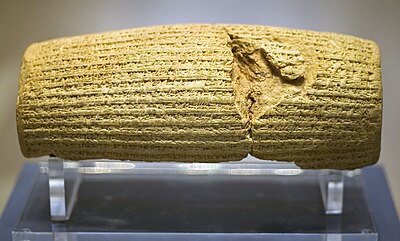
The Cyrus Cylinder is a barrel-shaped clay object, about 22.5 centimetres long, inscribed in Akkadian cuneiform on behalf of Cyrus II, the founder of the Achaemenid Persian Empire. It was made in Babylon shortly after Cyrus took the city in October 539 BCE, and it was meant to be buried in the foundations of a building, a long-standing Mesopotamian practice that addressed the gods and future kings rather than the public of the day.
Today the cylinder is in the British Museum in London. It is broken and incomplete: roughly a third of its roughly forty-five lines are damaged or missing, and modern readings depend on careful reconstruction. Even so, it is one of the most important documents for the moment when Nabonidus, the last king of independent Babylon, gave way to a Persian ruler, and for how that ruler wished to be seen by his new subjects.
What does the Cyrus Cylinder say?
The text falls into two parts. The first, written in the third person, condemns Nabonidus: he is accused of neglecting the worship of Marduk, the chief god of Babylon, of corrupting rituals, and of burdening the population with forced labour. Marduk, angered, searches the lands for a righteous king, takes Cyrus, king of Anshan, by the hand, and lets him enter Babylon without battle. The people of Babylon, Sumer and Akkad are said to greet him with joy.
The second part switches to the first person: I am Cyrus, king of the world, great king, mighty king, king of Babylon, king of Sumer and Akkad, king of the four quarters. Cyrus gives his genealogy as son of Cambyses, grandson of Cyrus and descendant of Teispes, all kings of Anshan, which is precious evidence for how the dynasty described itself before Darius I later emphasised the name Achaemenes. He says he relieved Babylon's inhabitants of their burdens, returned the statues of gods to sanctuaries along the Tigris and in the lands to the east, such as Ashur, Susa, Der and the land of the Guti, gathered their displaced people and resettled them, and repaired Babylon's city wall. He even mentions finding an inscription of the Assyrian king Ashurbanipal during the works.
Discovery and the missing pieces
The main cylinder was excavated in 1879 by Hormuzd Rassam, working for the British Museum, in the ruins of Babylon, probably in the area of the great Marduk temple, Esagila. In 1970 a separate fragment held at Yale University was recognised as belonging to the same object, filling part of the end of the text. In 2010 Irving Finkel of the British Museum identified two fragments of a clay tablet carrying the same wording, which showed that the text was copied and circulated beyond a single buried foundation deposit.
Propaganda, tradition and Persian policy
Scholars read the cylinder first of all as a skilful piece of royal self-presentation. Its structure follows Babylonian and Assyrian building inscriptions, and its picture of a wicked predecessor rejected by the gods was almost certainly shaped by Marduk's priesthood, who had their own grievances against Nabonidus. Babylonian chronicles confirm that the city fell with little resistance after a Persian victory at Opis, but the joyous welcome is the victor's version.
That does not make the cylinder empty words. Its approach, ruling through local gods, temples and elites rather than imposing a single religion, matches what we know of early Achaemenid practice across a very diverse empire. For Cyrus, a king from Anshan in Fars who had already absorbed Media and Lydia, presenting himself in Babylon as Marduk's chosen king was a practical and intelligent way to win acceptance from one of the oldest urban cultures in the world.
Historians therefore read the cylinder alongside other evidence rather than on its own. The Nabonidus Chronicle, a terse Babylonian record, gives the military sequence; the so-called Verse Account of Nabonidus repeats the same hostile picture of the old king; and Greek writers such as Herodotus and Xenophon, writing generations later, preserve legends rather than eyewitness detail. Together they suggest a real conquest by force at Opis followed by a deliberately gentle takeover of the city itself.
Does the Cyrus Cylinder mention the Jews?
No. The surviving text names no Jews, Jerusalem or Judah; the gods and peoples it mentions belong to Mesopotamia and the lands to its east. The connection comes from the Hebrew Bible, where the Book of Ezra records a decree of Cyrus allowing exiles to return and rebuild the Temple, and the Book of Isaiah calls him the Lord's anointed. Many historians see the cylinder's general policy of returning gods and people as consistent with that biblical memory, but the cylinder itself is not a decree about the Jews, and the precise wording in Ezra remains debated.
Is it the first charter of human rights?
The idea is modern. It was popularised in the twentieth century, above all around Mohammad Reza Shah's 1971 celebration of 2,500 years of Iranian monarchy, and a replica given to the United Nations in the same year helped spread it. Most specialists in ancient history reject the label: the text speaks of divine favour, royal legitimacy and the restoration of cults, not of individual rights or universal law, and words such as freedom of religion do not appear in it.
Yet the cylinder's modern life is real history too. For many Iranians, inside the country and in the diaspora, it has become a symbol of tolerance and of a pre-Islamic past they value, and its 2010 loan to the National Museum of Iran in Tehran drew very large crowds. A fair reading holds both truths together: in its own world the cylinder records an unusually conciliatory style of conquest, while the language of human rights belongs to the way later generations have chosen to remember it.
Frequently asked questions
What does the Cyrus Cylinder say?
It condemns the Babylonian king Nabonidus, says the god Marduk chose Cyrus to take Babylon peacefully, lists Cyrus's royal titles and ancestry, and claims he eased forced labour, returned divine statues and displaced people to their homes, and repaired Babylon's walls.
Where is the Cyrus Cylinder now?
It is in the British Museum in London, which has lent it for exhibitions abroad, including to the National Museum of Iran in Tehran in 2010–2011 and to several museums in the United States in 2013.
Is the Cyrus Cylinder the first human rights charter?
That description is a modern interpretation that most historians consider anachronistic. The text is a Babylonian-style royal inscription about legitimacy and restoring cults, though it does reflect a notably tolerant approach to conquered peoples.
What language is the Cyrus Cylinder written in?
It is written in Akkadian, the language of Babylon, in cuneiform script. It was aimed at a Babylonian audience, which is why it uses local religious language rather than Old Persian.
Key events on the map
- 539 BCE · Cyrus Enters Babylon
- 538 BCE · Cyrus Frees the Jews from Babylonian Captivity
- 530 BCE · Death of Cyrus the Great
- 1971 CE · 2,500-Year Celebration of Persian Empire
Guided storylines
- Cyrus Cylinder Translation — Livius.org
- CYRUS iii. Cyrus II The Great — Encyclopaedia Iranica
- Cyrus the Great — Livius.org
- ACHAEMENID DYNASTY — Encyclopaedia Iranica