Alexander's Conquest of Persia: Issus, Gaugamela and the Burning of Persepolis
How Alexander conquered the Persian Empire (334–330 BCE): Issus, Gaugamela, the burning of Persepolis and the fate of Darius III, beyond the legend.
 Open the interactive map
Alexander's conquest of Persia in brief
Alexander's conquest of Persia took a little over four years. In spring 334 BCE Alexander III of Macedon crossed into Anatolia with roughly 35,000 to 40,000 troops, inheriting a war planned by his father Philip II. By the summer of 330 BCE the Achaemenid capitals of Babylon, Susa and Persepolis were in his hands, and Darius III, the last Achaemenid king, was dead. Three moments were decisive: the battles of Issus (333 BCE) and Gaugamela (331 BCE), and the burning of Persepolis (330 BCE).
The story is usually told as the inevitable triumph of a young genius over a decadent empire. That picture comes largely from Greek and Roman writers such as Arrian, Diodorus, Quintus Curtius and Plutarch, who wrote three to five centuries later, drawing on lost accounts by Alexander's companions. Babylonian cuneiform chronicles and astronomical diaries, together with later Iranian tradition, offer partial correctives. They show an empire that fought hard, adapted and did not simply collapse.
From the Granicus to Issus (334–333 BCE)
Darius III had come to the throne in 336 BCE after a violent succession crisis at court, and he did not lead the first defence himself. In 334 BCE the satraps of western Anatolia met Alexander at the Granicus River and were defeated, after which most of the coastal Greek cities passed to the Macedonians. Darius's commander Memnon of Rhodes then pursued a promising naval counter-offensive in the Aegean, but his death in 333 BCE ended it.
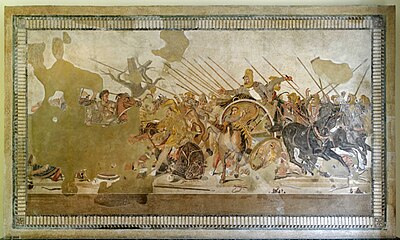
In November 333 BCE Darius brought the royal army to the coastal plain at Issus, near modern Iskenderun in southern Turkey, and actually came down behind Alexander, cutting his communications. The narrow ground between mountains and sea, however, prevented the Persians from using their numbers and cavalry fully. When Alexander's cavalry broke through and drove towards the king, Darius left the field. His mother Sisygambis, his wife and his children were captured in the camp, and Alexander treated them with conspicuous respect, a gesture the Greek sources emphasise.
Greek writers present Darius's departure as cowardice. Historians such as Pierre Briant have shown how much that image owes to Alexander's propaganda: the king's survival was essential to continuing the war, and Darius immediately raised a new army while offering peace terms that, according to the Greek sources, eventually included all lands west of the Euphrates.
Gaugamela: the battle that decided the empire
While Alexander spent 332 BCE besieging Tyre and taking Egypt, Darius assembled forces from the eastern satrapies, including Bactrian and Saka cavalry, scythed chariots and a few elephants. He chose a broad plain near Gaugamela, east of the Tigris and north-west of Arbela (modern Erbil), and levelled the ground for his chariots. The armies met on 1 October 331 BCE. Ancient figures for the Persian army, up to a million men, are fantasy; modern estimates are far lower, though Darius probably still outnumbered Alexander's roughly 47,000.
The Persian cavalry pressed Alexander's left wing hard, and some horsemen broke through to the Macedonian baggage camp. Alexander, however, exploited a gap that opened in the Persian line and led his Companion cavalry straight at the king's position. Darius withdrew again, and his army disintegrated. A Babylonian astronomical diary written at the time records a lunar eclipse eleven days before the battle and, in damaged lines, the defeat of the king and the desertion of his troops, a rare non-Greek witness to the event.
Gaugamela opened Mesopotamia and Iran to the Macedonians. Babylon surrendered under its governor Mazaeus, whom Alexander kept in office, and Susa with its treasury followed. Alexander's readiness to retain Persian officials showed that he wanted to inherit the empire's machinery, not destroy it.
The burning of Persepolis
The road into Persis itself was not open. At the Persian Gates, a pass in the Zagros, the satrap Ariobarzanes held Alexander back until the Macedonians found a way around, an Iranian last stand that modern writers sometimes compare to Thermopylae. Alexander reached Persepolis early in 330 BCE, allowed his troops to plunder the city and removed an enormous treasure from the palaces, reportedly requiring thousands of pack animals.
Some months later, in spring 330 BCE, the palaces on the great terrace burned. The ancient accounts disagree. Arrian presents the fire as a deliberate act of policy, revenge for Xerxes' burning of Athens in 480 BCE. Diodorus, Curtius and Plutarch tell of a drunken banquet at which the Athenian courtesan Thaïs urged the king to set the palace alight. Many historians suspect a calculated message to Greeks and Iranians alike that Achaemenid rule was over, later embroidered with dramatic detail. Excavations confirm intense burning in the treasury and the great halls, including the Apadana and the Hall of a Hundred Columns.
The loss was immense, but the ruins also preserved evidence. Thousands of clay administrative tablets survived at the site, and the staircases carved with delegations from across the empire stayed buried under debris until modern excavation.
The death of Darius III
After Gaugamela, Darius fell back to Ecbatana (Hamadan) and then eastward, hoping to rebuild his army from the Iranian plateau and Bactria. In July 330 BCE, as Alexander closed in, a group of nobles led by Bessus, satrap of Bactria, arrested the king and, when the pursuit came too near, mortally wounded him in Parthia, east of the Caspian Gates. A fragmentary Babylonian chronicle appears to record that Darius was removed from his throne and that Bessus took the royal name Artaxerxes, though much of its text is restored.
Alexander sent Darius's body to Persepolis for royal burial and presented himself as the avenger of the legitimate king, a role that helped him win over Persian nobles. He adopted elements of Persian court dress and ceremony, appointed Iranian satraps, married the Sogdian noblewoman Roxana and, at Susa in 324 BCE, a daughter of Darius. Resistance did not end with Darius: Bessus and then Spitamenes led a fierce war in Bactria and Sogdiana until about 327 BCE.
Legacy and memory in Iran
Alexander died in Babylon in 323 BCE, and his generals divided his conquests. Most of Iran passed to the Seleucid dynasty until the Parthians gradually displaced it during the third and second centuries BCE. Achaemenid administrative practices, Aramaic as a language of government and many local elites survived the change of rulers, so the conquest was as much a change of dynasty as a break in civilization.
Iranian memory of Alexander is double. Middle Persian Zoroastrian texts call him 'the accursed Alexander' and blame him for killing priests and destroying sacred texts, a tradition written down many centuries later and difficult to verify. Ferdowsi's Shahnameh, by contrast, makes Eskandar a son of the Iranian king Darab and so a half-brother of Dara (Darius), turning the conqueror into an Iranian prince. Both images say more about how later Iranians made sense of defeat than about the events of 334–330 BCE, but both show that Iranians never accepted the Greek story as the only one.
Frequently asked questions
When did Alexander conquer Persia?
Between 334 and 330 BCE. He crossed into Anatolia in 334 BCE, defeated Darius III at Issus in 333 BCE and at Gaugamela in 331 BCE, and took Persepolis early in 330 BCE. Darius was killed by his own nobles in July 330 BCE, though fighting in the eastern provinces continued until about 327 BCE.
Why did Alexander burn Persepolis?
The sources disagree. Arrian says it was deliberate revenge for the Persian burning of Athens in 480 BCE; Diodorus, Curtius and Plutarch describe a drunken banquet encouraged by the courtesan Thaïs. Many historians see a calculated political signal that the Achaemenid order had ended.
Who killed Darius III?
Darius III was killed in 330 BCE by his own nobles, led by Bessus, the satrap of Bactria, who then claimed the throne as Artaxerxes (V). Alexander later had Bessus executed and gave Darius a royal burial.
How did Alexander win the Battle of Gaugamela?
Darius had more troops and cavalry, but Alexander kept his line flexible, absorbed the Persian chariot and cavalry attacks, and drove his Companion cavalry through a gap towards the king. When Darius withdrew, the Persian army broke up.
Key events on the map
- 333 BCE · Battle of Issus: Alexander vs Darius III
- 331 BCE · Battle of Gaugamela
- 330 BCE · Burning of Persepolis
- 330 BCE · Death of Darius III
Guided storylines
- Alexander the Great — Encyclopaedia Iranica
- Darius v. Darius III — Encyclopaedia Iranica
- Battle of Gaugamela (331 BCE) — Livius.org
- BCHP 1 (Alexander Chronicle) — Livius.org
- Persepolis — Livius.org