1979 Iranian Revolution: Causes, Coalition and Outcomes
Why did the 1979 Iranian Revolution happen? The causes, the broad coalition against the shah, key events of 1978–79 and the outcomes, explained neutrally.
 Open the interactive map
What Was the 1979 Iranian Revolution?
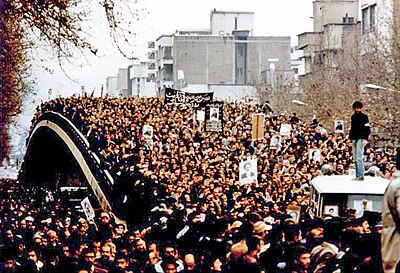
The 1979 Iranian Revolution was a mass uprising in 1978–79 that ended the Pahlavi monarchy and led to the founding of the Islamic Republic of Iran. Over roughly a year of demonstrations and strikes, a broad coalition of clerics, bazaar merchants, students, workers, secular nationalists and leftist groups mobilised against Mohammad Reza Shah. The shah left Iran on 16 January 1979, Ayatollah Ruhollah Khomeini returned from exile on 1 February, and on 11 February 1979 (22 Bahman 1357) the armed forces declared neutrality and the old government collapsed.
Measured by the share of the population that took part, it was, according to scholars such as Charles Kurzman, one of the largest popular revolutions in modern history, and it surprised most foreign governments and analysts. Its causes and meaning are still debated by scholars and by Iranians of very different political views. This article sets out the main explanations, the coalition that made the revolution, and its documented outcomes.
Long-Term Causes of the Revolution
Political causes are central to most accounts. After the 1953 coup the shah governed with growing personal authority. Parliament was tightly managed, independent parties were sidelined, and in 1975 the shah created a single party, Rastakhiz, which Iranians were urged to join. The security agency SAVAK monitored and repressed opponents, and Amnesty International and other human-rights organisations reported the torture of political prisoners.
Economic and social change also mattered. The White Revolution of 1963 brought land reform, votes for women and literacy programmes, but provoked opposition from many clerics and landowners; Khomeini's denunciations led to protests in June 1963 and to his exile in 1964. After oil prices quadrupled in 1973–74, ambitious spending overheated the economy. Inflation, housing shortages in fast-growing cities, the poverty of rural migrants and visible inequality fed resentment, and an austerity turn in 1977 hit many urban workers.
Ideas and institutions shaped how discontent was expressed. Jalal Al-e Ahmad's critique of gharbzadegi ("Westoxication") and Ali Shariati's reading of Shi'ism as a call to social justice reached many young, educated Iranians. In exile in Najaf, Khomeini developed the doctrine of velayat-e faqih, guardianship by the Islamic jurist, although it was not prominent in his public messages during 1978. Mosques, religious associations and bazaar networks offered nationwide organisation that secular opposition groups lacked.
How the Revolution Unfolded, 1977–1979
In 1977, partly in response to the Carter administration's emphasis on human rights, the government eased some controls, and lawyers, writers and students began to speak out publicly. In January 1978 a newspaper article attacking Khomeini, placed with government involvement, set off protests in Qom in which demonstrators were killed. The Shi'i custom of commemorating the dead after forty days produced a chain of protests in Tabriz, Yazd and other cities.
In August 1978 a fire at the Cinema Rex in Abadan killed several hundred people. Many Iranians at the time blamed SAVAK; after the revolution a 1980 trial convicted the man who confessed to setting the fire, whom later accounts linked to Islamist militants, and responsibility remains disputed. On 8 September 1978, the day martial law was declared, troops fired on protesters at Jaleh Square in Tehran, a day remembered as Black Friday. Rumours spoke of thousands killed; later research, notably by Emadeddin Baghi, counted fewer than one hundred deaths, but the shooting hardened opposition.
From October, strikes by oil workers and civil servants paralysed the economy. In December, during the Shi'i mourning days of Tasu'a and Ashura, enormous marches in Tehran called for the shah's departure. The shah, secretly ill with cancer and wavering between concession and force, appointed the veteran National Front politician Shapour Bakhtiar as prime minister and left the country. Khomeini returned, named Mehdi Bazargan to head a provisional government, and after fighting between air force technicians and the Imperial Guard, the military declared its neutrality on 11 February.
Who Made the Revolution? A Broad Coalition
The revolution was made by a coalition rather than a single party. It included clerics and their seminary and mosque networks; bazaar merchants and guilds; secular nationalists of the National Front and the Freedom Movement of Iran; leftist organisations such as the Fada'iyan-e Khalq, the People's Mojahedin and the Tudeh Party; university and high-school students; industrial and oil workers; and large numbers of women, both veiled and unveiled. They shared opposition to the shah far more than a common programme for what should follow.
Khomeini's uncompromising refusal to deal with the monarchy, his distance from the regime and the reach of religious networks made him the movement's recognised leader by late 1978. The sociologist Charles Kurzman has argued that many Iranians joined only once they came to believe the revolution could succeed, which helps explain why the movement grew so quickly and why so few observers predicted it.
Outcomes: From Monarchy to Islamic Republic
A referendum on 30–31 March 1979 approved an Islamic Republic, with an officially reported yes vote of more than 98 percent; some groups boycotted it. An elected Assembly of Experts drafted a constitution built around velayat-e faqih, which was approved by referendum in December 1979 and made Khomeini Supreme Leader. Revolutionary courts, whose summary trials were criticised by human-rights organisations, executed several hundred former officials, military officers and others in 1979–80.
The coalition did not hold. The seizure of the US embassy in November 1979 led to Bazargan's resignation and a 444-day hostage crisis. Between 1979 and 1983, liberal nationalists, the first president Abolhassan Banisadr, the Mojahedin and leftist parties were removed from power or suppressed, and armed conflicts broke out in Kurdistan and other regions. After the Mojahedin turned to armed struggle in June 1981 and bombings killed senior officials, thousands of opponents were executed, according to human-rights organisations. By 1983 factions loyal to Khomeini had consolidated control. Iraq's invasion in September 1980 began an eight-year war that further shaped the new state.
Social policy changed substantially. Compulsory hijab was introduced in the early 1980s, family law was revised, and universities were closed for several years during the Cultural Revolution of 1980–83. Other long-term trends, such as expanding literacy, women's education and rural services, continued. Abroad, the revolution ended Iran's alliance with the United States and reshaped politics across the region.
How Historians Explain the Revolution
Explanations differ mainly in emphasis. Ervand Abrahamian stresses uneven development, arguing that rapid economic modernisation outpaced political participation. Other scholars emphasise religion and culture, including the Shi'i language of martyrdom and the mobilising power of mourning rituals, or point to the shah's indecision and the army's eventual neutrality. Some Iranians attribute a decisive role to foreign powers, but the declassified American record shows a Washington that was divided and largely surprised by the speed of events. Interpretations in Iran and in the diaspora vary widely with political perspective, and debate over what the revolution sought and achieved remains part of Iranian public life.
Frequently asked questions
What caused the Iranian Revolution of 1979?
Historians point to a combination of factors: the shah's increasingly personal and repressive rule, economic strains after the 1970s oil boom, resentment of inequality and foreign influence, the organising power of religious networks, and Khomeini's leadership. Scholars weigh these causes differently.
Who took part in the 1979 revolution?
A broad coalition: clerics, bazaar merchants, secular nationalists, leftist groups, students, oil and industrial workers, and many women. After the monarchy fell, this coalition split, and factions loyal to Khomeini consolidated power by the early 1980s.
How many people died in the Iranian Revolution?
Figures are contested. Claims made during and soon after the revolution ran to tens of thousands, while later research by the Iranian researcher Emadeddin Baghi, cited by Charles Kurzman, counted roughly 2,800 deaths in 1978–79. No figure is universally accepted.
When did the shah leave Iran?
Mohammad Reza Shah left Iran on 16 January 1979 (26 Dey 1357). He never returned and died in exile in Cairo in July 1980.
Key events on the map
- 1979 CE · Iranian Revolution
- 1953 CE · 1953 CIA/MI6 Coup (Operation Ajax)
- 1963 CE · White Revolution
- 1964 CE · Khomeini Exiled
- 1973 CE · OPEC Oil Crisis and Iran's Oil Wealth
- 1975 CE · Founding of Rastakhiz Party
- 1979 CE · Iranian Hostage Crisis
- 1980 CE · Iran-Iraq War (1980–1988)
Guided storylines
- Foreign Relations of the United States, 1977–1980, Volume X, Iran: Revolution, January 1977–November 1979 — U.S. Department of State, Office of the Historian
- Khomeini — Encyclopaedia Iranica
- Constitution of the Islamic Republic — Encyclopaedia Iranica