Iran–Iraq War (1980–1988): Causes, Major Phases and Legacy
The Iran–Iraq War of 1980–1988 explained: why Iraq invaded, the major phases, chemical weapons, casualty estimates and UN Resolution 598.
 Open the interactive map
What Was the Iran–Iraq War?
The Iran–Iraq War was fought between Iran and Iraq from September 1980 to August 1988. It began when Iraqi forces under Saddam Hussein invaded southwestern Iran, and it ended in a UN-brokered ceasefire with the border essentially unchanged. Lasting nearly eight years, it was one of the longest conventional wars of the twentieth century, marked by trench warfare, mass infantry assaults, missile attacks on cities, attacks on oil shipping and Iraq's repeated use of chemical weapons.
In Iran the conflict is commonly called the Imposed War or, officially, the Sacred Defence; Saddam Hussein's government called it Qadisiyat Saddam, recalling the seventh-century Arab victory over the Sasanian army at Qadisiyya. These names show how each state framed the war, and its memory continues to shape politics and society in both countries.
Why Did Iraq Invade Iran?
The dispute over the Shatt al-Arab, known in Iran as the Arvand Rud, long predated the revolution. Under the 1975 Algiers Agreement, made while the shah was backing a Kurdish rebellion in Iraq, Iraq accepted a river boundary along the deepest channel in return for an end to Iranian support for the Kurds. Many in Iraq's leadership saw the agreement as a concession extracted under pressure.
The 1979 revolution changed the balance. Iran's army had been weakened by purges and desertions, its alliance with the United States had collapsed, and Iraq's Ba'athist government feared that revolutionary appeals would stir Iraq's Shi'i majority; Iranian leaders openly called for the Ba'athists' overthrow, and an Iraqi Shi'i opposition was active. Saddam Hussein appears to have expected a short war that would secure the whole waterway, possibly gain territory in oil-rich Khuzestan and make Iraq the leading power in the Gulf. After months of border clashes, Iraq declared the Algiers Agreement void on 17 September 1980 and launched a full invasion on 22 September.
Responsibility was argued for years. Iraq said it was responding to Iranian provocations and shelling. In December 1991 a report by the UN Secretary-General, prepared under Resolution 598, identified Iraq's attack of 22 September 1980 as the act that could not be justified under international law.
Major Phases of the Iran–Iraq War
Iraqi offensive and Iranian recovery, 1980–1982. Iraqi forces took Khorramshahr after weeks of street fighting in October 1980 and besieged Abadan, but the invasion stalled against regular troops, the Revolutionary Guards and volunteers. In 1981–82 Iran counterattacked, lifting the siege of Abadan and, in May 1982, recapturing Khorramshahr.
Iranian offensives into Iraq, 1982–1987. Iraq withdrew most of its forces from Iranian territory and proposed a ceasefire, but Iran's leadership chose to carry the war into Iraq, demanding Saddam's removal and reparations. Repeated offensives toward Basra and through the southern marshes brought very heavy losses for limited gains; the capture of the Fao peninsula in 1986 was Iran's most notable success. Iran relied heavily on the Revolutionary Guards and Basij volunteers, including large infantry assaults, while Iraq relied on fortified lines, artillery and air power.
The war widened. Both sides fired missiles and bombs at each other's cities in what became known as the War of the Cities, and from 1984 attacked oil tankers in the Gulf. In 1987 the United States began escorting reflagged Kuwaiti tankers, leading to clashes with Iranian forces. In July 1988 the USS Vincennes shot down Iran Air Flight 655, killing all 290 people aboard; the United States said the airliner had been mistaken for a warplane, while Iran called the attack deliberate. In 1996 the United States agreed to pay compensation to the victims' families without admitting legal liability.
The final phase, 1988. Iraq, rearmed and backed by foreign credit, recaptured Fao and other positions in the spring of 1988, often with the help of chemical weapons. Facing military reverses, economic exhaustion and international isolation, Iran accepted a ceasefire.
Chemical Weapons in the Iran–Iraq War
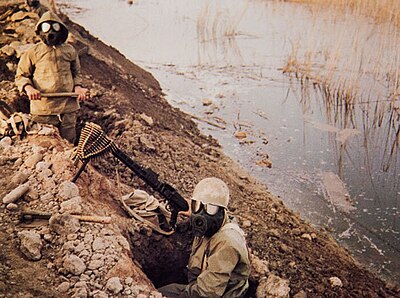
Iraq used chemical weapons, chiefly mustard gas and later nerve agents such as tabun, against Iranian forces from 1983 onward, and in June 1987 against the Iranian Kurdish town of Sardasht, where Iranian sources report more than 100 civilians killed and thousands injured. Specialist teams sent by the UN Secretary-General confirmed their use in 1984 and in later missions. Many Iranian veterans and civilians exposed to mustard gas still suffer chronic lung, eye and skin injuries; Iranian figures put the number exposed in the tens of thousands or more.
Iraq also used chemical weapons against its own Kurdish population. In the attack on Halabja on 16 March 1988, shortly after the town fell to Iranian forces and Iraqi Kurdish fighters, an estimated 3,200 to 5,000 people were killed, most of them civilians. Halabja coincided with the Anfal campaign against Iraqi Kurds (1987–89, with its main phase in 1988), which Human Rights Watch documented as genocide. International reaction at the time was muted. Allegations of limited Iranian chemical use were raised during the war, but they remain disputed and poorly documented.
Foreign Support and Casualties
Both sides received outside help. Iraq was financed by loans from Saudi Arabia, Kuwait and other Gulf states and bought most of its weapons from the Soviet Union and France; in 1982 the United States removed Iraq from its list of state sponsors of terrorism and later shared intelligence with Baghdad, as declassified US documents show. Iran, facing an arms embargo, obtained weapons from various sources including Syria, Libya, North Korea and China, and secretly from the United States and Israel in the Iran–Contra affair of 1985–86.
Casualty figures are uncertain and contested. Estimates of total deaths range from several hundred thousand to around one million. Iran's official figures put its own dead at roughly 200,000, while some outside estimates are considerably higher; estimates of Iraqi deaths commonly range from about 100,000 to several hundred thousand. Hundreds of thousands more were wounded, millions were displaced, and tens of thousands of prisoners of war were held for years, some not repatriated until the early 2000s. Damage to cities, oil installations and economies ran to hundreds of billions of dollars.
Resolution 598 and the End of the War
On 20 July 1987 the UN Security Council unanimously adopted Resolution 598. It demanded an immediate ceasefire, withdrawal to internationally recognised boundaries, the release of prisoners and UN-mediated negotiations, and it asked for an impartial inquiry into responsibility for the conflict. Iraq said it would comply, while Iran withheld acceptance for a year, arguing that the resolution did not name Iraq as the aggressor.
On 18 July 1988 Iran formally accepted the resolution. Ayatollah Khomeini likened the decision to drinking a cup of poison but said he accepted it in the interest of the country. The ceasefire took effect on 20 August 1988 and was monitored by the UN Iran–Iraq Military Observer Group (UNIIMOG). In August 1990, shortly after invading Kuwait, Saddam Hussein agreed to return to the 1975 boundary arrangements.
The war left both countries devastated. In Iran it strengthened post-revolutionary institutions, especially the Revolutionary Guards, and encouraged an emphasis on military self-reliance; in Iraq, heavy war debts contributed to the invasion of Kuwait. Commemoration of the dead, veterans and chemical-weapons survivors remains an important part of public life in Iran, and the war's memory is interpreted differently across political perspectives in both countries.
Frequently asked questions
Who started the Iran–Iraq War?
Iraq launched a full-scale invasion of Iran on 22 September 1980, after months of border clashes and mutual hostility. A 1991 report by the UN Secretary-General identified that Iraqi attack as the act that could not be justified under international law.
How many people died in the Iran–Iraq War?
No precise figure exists. Estimates of total deaths range from several hundred thousand to around one million. Iran's official count of its dead is about 200,000, and Iraqi deaths are usually estimated at between about 100,000 and several hundred thousand.
What is UN Resolution 598?
Resolution 598, adopted unanimously by the Security Council on 20 July 1987, demanded a ceasefire, withdrawal to international borders and prisoner exchanges between Iran and Iraq. Iran accepted it in July 1988, and the ceasefire began on 20 August 1988.
Did Iraq use chemical weapons against Iran?
Yes. In reports from 1984 onward, UN investigators confirmed repeated Iraqi use of mustard gas and nerve agents against Iranian forces, and Iraq also used chemical weapons against Kurdish civilians, most notoriously at Halabja in March 1988.
Key events on the map
- 1980 CE · Iran-Iraq War (1980–1988)
- 1979 CE · Iranian Revolution
- 1988 CE · Halabja Chemical Attack
- 1991 CE · Gulf War (Operation Desert Storm)
- Iraq vii. Iran–Iraq War — Encyclopaedia Iranica
- Security Council Resolution 598 (1987) — United Nations
- United Nations Iran–Iraq Military Observer Group (UNIIMOG): Background — United Nations Peacekeeping
- Genocide in Iraq: The Anfal Campaign Against the Kurds — Human Rights Watch
- Shaking Hands with Saddam Hussein: The U.S. Tilts toward Iraq, 1980–1984 — National Security Archive, George Washington University