Shapur I and Valerian: The Roman Emperor Captured by Persia (260 CE)
How Sasanian king Shapur I captured the Roman emperor Valerian in 260 CE, what the Naqsh-e Rostam reliefs show, and how the story was later distorted.
 Open the interactive map
Shapur I and the capture of Valerian
In 260 CE, in a battle between Carrhae (Harran) and Edessa (modern Şanlıurfa in south-eastern Turkey), the Sasanian king Shapur I defeated a Roman field army and took the emperor Valerian prisoner. Valerian became the first Roman emperor to be captured by a foreign enemy. He was never released and died in Iran. Shapur turned the victory into a monument: he described it in a long trilingual inscription and carved it into the cliffs of Fars, most famously at Naqsh-e Rostam near Persepolis.
Shapur was the son of Ardashir I, who had overthrown the last Parthian king and founded the Sasanian dynasty in the 220s. Co-ruler with his father from about 240 and sole king until his death around 270–272, Shapur was the first ruler to call himself 'King of Kings of Iran and non-Iran', a title that expressed his claim to rule over peoples beyond the Iranian heartland. His wars with Rome were central to that claim.
Three emperors: Shapur's wars with Rome
The first round came in 243–244 CE, when the young emperor Gordian III invaded Mesopotamia. Shapur says he met the Romans at Misiche on the Euphrates, west of Ctesiphon, and destroyed their army, renaming the place Peroz-Shapur, 'Victorious is Shapur'. Gordian died during the campaign; Roman writers tell of murder or illness rather than defeat. His successor, Philip the Arab, made peace and, according to Shapur, paid 500,000 denarii, a settlement Roman sources describe far more modestly.
Disputes over Armenia renewed the war. Around 252–253 CE Shapur defeated a Roman army at Barbalissos on the Euphrates and swept into Syria, taking dozens of cities including the great metropolis of Antioch; the exact date of Antioch's fall, 253 or 256, is still debated. Thousands of captives were carried back to Iran.
In 260 CE Valerian marched east with an army that Shapur numbers at 70,000, drawn from provinces across the empire. Shapur's inscription states that a great battle took place 'beyond Carrhae and Edessa' and that he captured Valerian 'with our own hands', together with the praetorian prefect, senators and officers. Some later Roman writers claim instead that Valerian was seized during negotiations, a version that may also have softened the humiliation.
Shapur's own account: the Ka'ba-ye Zartosht inscription
Unusually for an ancient war, we have the victor's own words. Shapur's great inscription was carved in Middle Persian, Parthian and Greek on the walls of the Ka'ba-ye Zartosht, a stone tower of Achaemenid date that stands opposite the royal tombs at Naqsh-e Rostam. Excavators uncovered its three versions in the late 1930s. Scholars often call it the Res Gestae Divi Saporis, after the Latin record of Augustus's deeds. It lists the provinces of the empire, recounts the three Roman wars, names the cities taken, and records the sacred fires and offerings Shapur established for the souls of his family and court.
The text is royal propaganda, written to glorify the king and his god-given fortune; it presents Philip as a tributary and gives figures for the Roman armies but none for Iranian losses. Roman writers, for their part, minimized or explained away each defeat. Reading both sides together is essential. Where they overlap, as on Gordian's failed invasion, Philip's costly peace and Valerian's capture, the outline of events is secure even if the interpretation is not.
The Naqsh-e Rostam relief: reading the stone
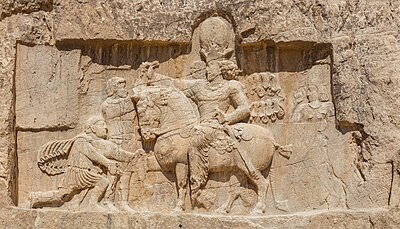
At Naqsh-e Rostam, directly beneath the rock-cut tomb of Darius I, Shapur carved his triumph. The king sits on horseback wearing a crenellated crown topped by a large globe. Before him, a Roman in a cloak kneels with hands outstretched, generally identified as Philip the Arab begging for peace, while Shapur grips the wrist of a standing Roman, generally identified as Valerian, his prisoner. Some scholars have read the figures differently, and the scene is symbolic rather than a snapshot: Philip was never captured. A generation later, a bust and inscription of the high priest Kerdir were added nearby.
The setting was a deliberate statement. By placing his victory beneath the tombs of the ancient kings of Fars, Shapur tied the young Sasanian house to the most prestigious royal landscape in Iran. Whether the Sasanians knew the tomb owners as 'Achaemenids' is debated, but they clearly saw the site as a place of ancient kingship. Other versions of the triumph appear at Bishapur, where the dead Gordian lies beneath the royal horse, at Darabgerd, and on a carved sardonyx cameo now in Paris showing Shapur seizing Valerian in combat.
What happened to Valerian? Facts and legends
Reliable facts are few. Valerian died in captivity at an unknown date, and his son and co-emperor Gallienus did not, or could not, secure his release. The most lurid account comes from the Christian writer Lactantius, writing around 315 CE, who claims that Shapur used the old emperor as a footstool for mounting his horse and, after his death, had him flayed and his skin dyed red and hung in a temple. Lactantius wrote to show divine punishment of rulers who had persecuted Christians, as Valerian did in 257–258 CE. No Iranian source supports the story, and most historians treat it as polemic rather than reporting.
Better attested is what happened to the many Roman prisoners. Shapur's inscription says he settled them in Persis, Parthia, Khuzestan and other provinces. Their skills shaped new foundations such as Gundishapur, whose Middle Persian name meant roughly 'Shapur's better Antioch', and Bishapur. Tradition credits Roman captives with building the Band-e Kaisar, the bridge-dam at Shushtar. Christians among the deportees also helped establish Christian communities in the Sasanian empire.
Why the capture of Valerian matters
The victory did not make Shapur master of Rome's eastern provinces. On his way home he was harassed by Odaenathus of Palmyra, who then restored Roman control over much of the frontier, and Syria was never held. What 260 CE did achieve was to prove that the new Sasanian dynasty could defeat Rome's emperors in person, a claim Shapur's successors repeated in their own reliefs. For Rome, the capture deepened the crisis of the third century.
Today the Naqsh-e Rostam relief is one of the most photographed monuments in Iran and a powerful symbol of Iranian pride. It is best understood on its own terms: a carefully staged image of kingship, matched by an equally partisan Roman tradition, behind which lies a real and remarkable victory.
Frequently asked questions
Which Persian king captured a Roman emperor?
Shapur I, the second king of the Sasanian dynasty, captured the Roman emperor Valerian in 260 CE after a battle between Carrhae and Edessa. Valerian was the first Roman emperor taken prisoner by a foreign enemy, and he died in captivity in Iran.
What happened to Emperor Valerian after his capture?
He remained a prisoner in Iran until his death, at an unknown date. The famous stories that Shapur used him as a footstool and later had him flayed come from the Christian writer Lactantius, writing decades later with a religious purpose, and are generally regarded as unreliable.
Where is the relief of Shapur and Valerian?
The best-known version is at Naqsh-e Rostam, about 6 km north-west of Persepolis in Fars province, carved beneath the tomb of Darius I. Related triumph reliefs are at Bishapur near Kazerun and at Darabgerd.
How many Roman emperors did Shapur I defeat?
Shapur claimed victories over three: Gordian III, whose invasion failed at Misiche in 244 CE; Philip the Arab, who made a costly peace; and Valerian, whom he captured in 260 CE. Roman sources dispute details, especially how Gordian died.
Key events on the map
- 260 CE · Shapur I Captures Roman Emperor Valerian
- 490 BCE · Naqsh-e Rostam Royal Tombs
- 240 CE · Reign of Shapur I
- 271 CE · Academy of Gundishapur
Guided storylines
- Šāpur I: History — Encyclopaedia Iranica
- Naqš-e Rostam — Encyclopaedia Iranica
- Naqš-e Rustam, Relief of Shapur I — Livius.org
- Shapur I — Livius.org
- Lactantius, Of the Manner in Which the Persecutors Died — New Advent