Persia vs Rome: 700 Years of Rivalry
Persia vs Rome: how Parthian and Sasanian Iran fought Rome and Byzantium for 700 years, from Carrhae in 53 BCE to Heraclius and the war of 602–628.
 Open the interactive map
Persia vs Rome at a glance
The rivalry between Persia and Rome is one of the longest in recorded history. For roughly seven centuries, from the Battle of Carrhae in 53 BCE to the peace that ended the war of 602–628 CE, two Iranian dynasties, first the Parthian Arsacids and then the Sasanians, faced the Roman Republic, the Roman Empire and finally its eastern continuation, which modern historians call Byzantium. Neither side ever destroyed the other. The frontier swung back and forth across Upper Mesopotamia and Armenia, yet in 628 it stood not far from where it had stood for centuries.
Who tells the story matters. Most surviving narratives are Greek and Latin: Plutarch, Cassius Dio, Ammianus Marcellinus, Procopius and Theophylact Simocatta. Iranian voices survive mainly in royal inscriptions and rock reliefs, above all Shapur I's trilingual inscription on the Ka'ba-ye Zardosht at Naqsh-e Rostam, in coins, and in later Arabic and Persian histories such as al-Tabari and the Shahnameh, which preserve Sasanian court traditions. A balanced account reads Roman and Iranian claims against each other.
Parthia and Rome: from Carrhae to Nisibis (53 BCE–217 CE)
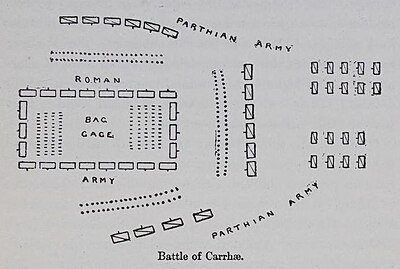
Formal contact began in 96 BCE, when a Parthian envoy met the Roman commander Sulla on the Euphrates. War came in 53 BCE, when Marcus Licinius Crassus invaded Mesopotamia without clear provocation. Near Carrhae (Harran, in today's southeastern Turkey) the Parthian general Surena, with a smaller force of horse archers and armoured cataphracts backed by a camel train carrying spare arrows, wore down the legions. Crassus was killed during a parley. Plutarch reports some 20,000 Romans dead and 10,000 captured; the figures cannot be checked, but the scale of the disaster is not in doubt, and Parthia kept the captured legionary standards.
Rome tried again. Parthian forces under the prince Pacorus and the Roman renegade Quintus Labienus overran Syria and much of Anatolia in 40 BCE before being driven back. In 36 BCE Mark Antony marched into Media Atropatene (Azerbaijan); Phraates IV destroyed his siege train, and Antony lost a large part of his army on the retreat. Augustus chose diplomacy instead: in 20 BCE Phraates returned the standards and prisoners, and Roman propaganda presented this negotiated deal as a triumph.
Armenia became the main point of dispute. The compromise of 63 CE, sealed when Nero crowned the Arsacid prince Tiridates in Rome in 66, left an Arsacid on the Armenian throne under Roman investiture. Rome's greatest offensives came in the second century: Trajan took Ctesiphon in 116 and reached the Persian Gulf, but revolts forced Hadrian to abandon the new provinces, and Roman armies sacked Ctesiphon again in 165 and 198. Parthia endured. At Nisibis in 217 Artabanus IV fought Emperor Macrinus to a standstill, after which Rome paid a large indemnity, about 200 million sesterces according to Cassius Dio.
The Sasanian challenge: Shapur I and a captive emperor (224–363)
In 224 Ardashir I overthrew Artabanus IV and founded the Sasanian dynasty. Roman authors claimed Ardashir meant to recover all the lands once held by the Achaemenids, but that claim survives only in Roman sources and may reflect Roman fears more than Sasanian policy. His son Shapur I recorded three great victories: in 244 the young emperor Gordian III died after a battle at Misiche (renamed Peroz-Shapur), and his successor Philip agreed to pay 500,000 denarii; around 252–253 Shapur destroyed a Roman army at Barbalissos and went on to sack Antioch; and in 260 he captured Emperor Valerian near Edessa.
Valerian's capture was without precedent: no Roman emperor had ever been taken alive by a foreign enemy. Roman sources disagree on whether he was seized in battle or during negotiations. Shapur's own version appears in his inscription and in rock reliefs at Naqsh-e Rostam and Bishapur, where emperors kneel or stand captive before the mounted king of kings. Roman prisoners were settled in Iranian cities such as Bishapur and Gundeshapur, and their skills probably contributed to projects like the bridge-dam at Shushtar.
The pendulum kept swinging. Emperor Carus reached Ctesiphon in 283 but died there, and in 298 Galerius defeated Narseh, forcing the Peace of Nisibis that pushed the border beyond the Tigris. Shapur II reversed this. In 363 Emperor Julian marched down the Euphrates to Ctesiphon but could not take it; harassed on the retreat, he was mortally wounded in a skirmish. His successor Jovian, trapped with a hungry army, surrendered Nisibis, Singara and five districts east of the Tigris, a peace Roman writers called shameful.
Armenia, the Caucasus and an uneasy coexistence (363–602)
After 363 the two powers fought less and negotiated more. Around 387 they partitioned Armenia, with the larger share going to Persia. The fifth century saw only brief wars in 421–422 and 440, partly because both empires faced threats elsewhere: Huns and Hephthalites on Persia's northern and eastern frontiers, Germanic and Hunnic invaders in the Roman west. Diplomacy developed shared conventions. A letter of Khosrow II preserved by Theophylact Simocatta describes the two empires as the 'two eyes' through which God illuminates the world.
A recurring dispute concerned the defence of the Caucasus passes against northern nomads. Persia garrisoned them, notably at Darband, and argued that Rome should share the cost; Roman payments, which Persia could present as tribute and Rome as subsidies, became a regular part of peace treaties. When Emperor Anastasius refused, Kavad I invaded and took Amida in 502–503. Justinian's wars with Kavad and then Khosrow I Anushirvan ended in the 'Eternal Peace' of 532, which cost Rome 11,000 pounds of gold. Khosrow broke it in 540 by sacking Antioch, and the Fifty Years' Peace of 562 fixed annual Roman payments.
The rivalry was commercial and religious as well as military. Both empires sought to control the silk trade and the Arabian and Red Sea routes, and both backed Arab client kingdoms, the Lakhmids for Persia and the Ghassanids for Rome. Persia's Christians were at times suspected of Roman loyalties and persecuted.
The last great war: Khosrow II and Heraclius (602–628)
The final war began as a family matter. In 591 Emperor Maurice had helped the young Khosrow II recover his throne from the rebel general Bahram Chobin, receiving much of Armenia in return. When Maurice was murdered by the usurper Phocas in 602, Khosrow declared war to avenge his patron. Sasanian armies under generals such as Shahrbaraz and Shahin took Dara, Edessa and Antioch, captured Jerusalem in 614 and carried off the relic of the True Cross, conquered Egypt between about 618 and 621, and reached the Bosporus. In 626, alongside Avar allies, they besieged Constantinople itself.
Emperor Heraclius, who had overthrown Phocas in 610, answered by striking at the Iranian heartland rather than defending his capital directly. From 622 he campaigned through Armenia and Azerbaijan, destroyed the great fire temple of Adur Gushnasp at Takht-e Soleyman in 624, allied with the Western Turks, and in December 627 defeated a Persian army near Nineveh before plundering the royal palace at Dastagird. In February 628 Khosrow II was deposed and killed by his own nobles in favour of his son Kavad II, who made peace on the basis of the pre-war borders. The True Cross was returned to Jerusalem around 630.
The victory was hollow for both sides. Decades of war had drained treasuries, and Persia fell into a succession crisis, with around ten rulers or claimants in four years. Within a decade Arab armies defeated the Byzantines at the Yarmuk in 636 and the Sasanians at Qadisiyya around 636–637. Byzantium lost Syria and Egypt but survived; the Sasanian state collapsed, ending with the death of Yazdegerd III in 651.
Who won the Roman–Persian wars?
Neither, in any lasting sense. Measured by territory, the long contest was close to a draw: Rome's deepest gains in Mesopotamia did not last, and Persia's occupation of the Levant and Egypt lasted little more than a decade. Each side won famous victories, Carrhae, Nisibis, Edessa and the defeat of Julian for Iran, and the sacks of Ctesiphon, Galerius' triumph and Nineveh for Rome, but none proved decisive. Geography helped: deserts, mountains and long supply lines made deep conquests very hard to hold.
The rivalry also shaped both civilisations. Rome developed heavy cavalry partly modelled on Iranian cataphracts, and some historians see Persian influence in late Roman court ceremony, though the extent is debated. People and ideas crossed the frontier in both directions: after Justinian's restrictions on pagan teaching in 529, several Athenian philosophers spent time at the court of Khosrow I, and the peace of 532 guaranteed their safe return. For the Parthian side of the story, and for how later legends grew around it, see our storyline on Parthia and Rome.
Frequently asked questions
Who won the Roman–Persian wars?
Neither side won outright. Over about seven centuries both empires scored major victories, but the frontier in Mesopotamia and Armenia shifted only moderately, and the last war (602–628) left both so exhausted that the early Islamic conquests overran the Sasanian Empire and stripped Byzantium of Syria and Egypt.
Who won the Battle of Carrhae?
The Parthians. In 53 BCE the Parthian general Surena defeated the Roman triumvir Crassus near Carrhae (Harran), using horse archers resupplied with arrows and heavily armoured cataphracts. Crassus was killed and Parthia captured Roman legionary standards, which were returned only in 20 BCE through negotiation with Augustus.
Was a Roman emperor ever captured by the Persians?
Yes. In 260 CE the Sasanian king Shapur I captured Emperor Valerian near Edessa, the only Roman emperor ever taken prisoner by a foreign enemy. Shapur commemorated the event in his inscription at Naqsh-e Rostam and in rock reliefs; Valerian died in captivity, though Roman accounts of his treatment are unreliable.
Why did Rome and Persia fight for so long?
The two empires were roughly matched and met along a frontier that was hard to conquer and harder to hold. They competed for Armenia and the Caucasus, the fortress cities of Upper Mesopotamia, trade routes and Arab allies, and quarrels over payments for defending the Caucasus passes repeatedly reopened war.
Key events on the map
- 53 BCE · Battle of Carrhae
- 36 BCE · Mark Antony's Parthian Campaign
- 116 CE · Trajan's Invasion of Parthia
- 117 CE · Roman Empire at Greatest Extent Under Trajan
- 217 CE · Battle of Nisibis (217 CE)
- 260 CE · Shapur I Captures Roman Emperor Valerian
- 363 CE · Death of Emperor Julian in Persia
- 627 CE · Byzantine Counter-offensive under Heraclius
Guided storylines
- Byzantine-Iranian Relations — Encyclopaedia Iranica
- Carrhae — Encyclopaedia Iranica
- Šāpur I: History — Encyclopaedia Iranica
- Heraclius — Encyclopaedia Iranica
- Carrhae (53 BCE) — Livius.org