Iran and China on the Silk Road: 2,000 Years of Contact
Iran and China on the Silk Road: Parthian–Han envoys, Sasanian embassies to the Tang, Peroz III in Chang'an, Sogdian merchants and Ilkhanid–Yuan exchange.
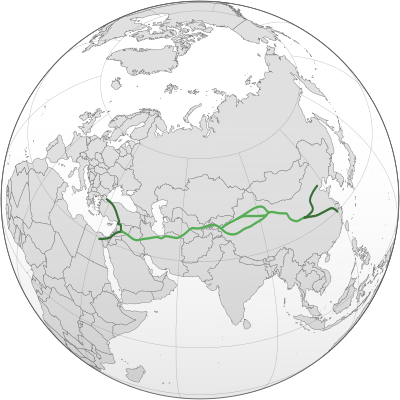 Open the interactive map
Iran and China on the Silk Road: an overview
Iran and China sat at opposite ends of the overland routes that linked Asia, and for about two thousand years they traded, exchanged envoys and borrowed from each other along the Silk Road. Chinese chronicles called Parthia Anxi, probably from the dynastic name Arsak, and later called Iran Bosi, from Pars. Iranian-speaking merchants, monks, refugees and craftsmen carried goods and ideas east; Chinese silk, paper and later porcelain and administrative techniques moved west.
The term 'Silk Road' itself is modern, coined by the German geographer Ferdinand von Richthofen in 1877. It was never a single road but a shifting web of caravan routes and sea lanes, and Iran's position across them made it both a middleman and a partner. Much of what we know comes from Chinese dynastic histories, which recorded foreign embassies in the language of tribute; Iranian sources say less, so archaeology, coins and inscriptions fill many gaps.
Parthia and Han China: envoys, ostrich eggs and a monk
Direct contact begins with the Han envoy Zhang Qian, whose missions to Central Asia between about 138 and 115 BCE first brought reliable reports of Anxi to the Chinese court. According to Sima Qian's Records of the Grand Historian, when a Han embassy reached Parthia around the 110s BCE, the Parthian king sent a large mounted escort to meet it at the eastern frontier, a figure of 20,000 horsemen that is probably inflated, and later sent envoys to China with ostrich eggs and skilled performers. Parthia's control of the routes between China and the Mediterranean made it rich as a commercial middleman.
That role shaped a famous episode. In 97 CE the Han general Ban Chao sent his officer Gan Ying west to reach Daqin, the Roman world. Gan Ying reached a western sea, probably the Persian Gulf, where Parthian sailors warned him that the crossing could take up to two years, and he turned back. The Later Han History implies the Parthians wanted to keep the silk trade in their own hands; that is a plausible reading but it remains an interpretation. Exchange was cultural too: around 148 CE a Parthian prince-turned-monk known in Chinese as An Shigao arrived in Luoyang and became one of the first translators of Buddhist texts into Chinese.
The Sogdians: Iranian merchants between two worlds
No group did more to connect Iran and China than the Sogdians, an Iranian-speaking people centred on Samarkand and Bukhara in today's Uzbekistan. From at least the fourth century they ran a trading diaspora with communities across the Tarim Basin and northern China. The so-called Sogdian Ancient Letters, found near Dunhuang and usually dated to around 313 CE, are private and business letters that describe the sack of Luoyang in 311 and the troubles of merchants far from home.
Sogdians served Chinese states as caravan leaders, interpreters, soldiers and officials. Tombs of Sogdian community heads in Xi'an, such as those of An Jia and Shi Jun (Wirkak) from around 579–580, combine Chinese funerary forms with Zoroastrian-inspired imagery. Sogdian became a lingua franca of Central Asian trade, and Sogdians helped carry Zoroastrian, Manichaean, Buddhist and Christian ideas east. Their prominence also had a political edge: An Lushan, the general of partly Sogdian descent whose rebellion of 755 shook the Tang dynasty, was a product of this frontier world.
Sasanian Persia and the Tang: embassies, silver and faiths
Chinese histories record Sasanian embassies to the Northern Wei court from 455 CE and later to other dynasties. Archaeology confirms the connection: well over a thousand Sasanian silver coins have been found in China, especially along the routes through Turfan and the northwest, together with Sasanian-style silver vessels and glass. Sasanian textile designs, such as paired animals inside pearl roundels, were imitated in Central Asian and Chinese silks.
Under the Tang dynasty, founded in 618, the capital Chang'an became one of the most cosmopolitan cities in the world. Persian and Sogdian communities maintained Zoroastrian temples; the Church of the East, whose missionary Aluoben arrived in 635, was first known in China as the 'Persian religion'; and Manichaeism reached the court in 694. A bilingual Middle Persian and Chinese epitaph from Xi'an, dated 874, commemorates a Persian woman named Mashi, the wife of Su Liang, showing that Iranian families kept their language and faith in China for generations.
Peroz III in Chang'an: the last Sasanian court in exile
As Arab armies advanced, Yazdegerd III sent envoys to the Tang emperor Taizong in 638 asking for help; Taizong declined, citing the distance. After Yazdegerd's death in 651, his son Peroz III took refuge in Tokharistan, in today's northern Afghanistan, and appealed to China again. In 661 the Tang named a 'Persian Area Command' in Sistan and made Peroz its governor, an office that was largely symbolic because the Tang could not project power that far.
Peroz reached Chang'an in the early 670s and received the title General of the Right Militant Guard. In 677 he asked permission to build a 'Persian temple' in the city; whether it was Zoroastrian or Christian is still debated. He died around 679. His son Narseh set out with a Tang escort to recover Iran, but the expedition stopped in Central Asia; he spent some twenty years in Tokharistan before returning to Chang'an around 707, where he died. Among the stone statues of foreign dignitaries at Qianling, the tomb of Emperor Gaozong, one was recorded as representing Peroz, king of Persia.
Ilkhanid Iran and Yuan China: one family, two courts
After the Islamic conquests, trade continued by land and increasingly by sea, with Persian-speaking merchants active in southern Chinese ports such as Guangzhou. The most intense exchange, however, came after the Mongol conquests. Hulagu, founder of the Ilkhanate in Iran in 1256, and Kublai, who founded the Yuan dynasty in China in 1271, were brothers, and the Ilkhans long acknowledged the Great Khan in China as their overlord. Envoys, officials and specialists moved between the two courts.
The Yuan official Bolad, who came to Iran in 1285 and stayed for the rest of his life, became a key informant for the vizier Rashid al-Din, whose Compendium of Chronicles includes a history of China. Rashid al-Din's circle also produced Persian translations of Chinese medical works. A Chinese scholar worked at Nasir al-Din Tusi's observatory at Maragheh, while the Persian astronomer Jamal al-Din brought astronomical instruments and a new calendar to Kublai's court in 1267. Not every borrowing worked: an attempt to introduce Chinese-style paper money in Tabriz in 1294 collapsed within weeks. In art, Chinese lotuses, dragons and phoenixes entered Ilkhanid tiles and painting, and Iranian cobalt helped make early Chinese blue-and-white porcelain possible.
Legacy: what the long exchange left behind
The relationship was never equal or constant. It flourished when strong states controlled the routes, as under the Han and Parthians, the Tang and Sasanians, and the Yuan and Ilkhans, and faded when they fragmented. Some popular claims need care: Chinese records traditionally credit Zhang Qian with bringing grapes and alfalfa from the west, but these attributions were made later, and proposed Iranian origins for some Chinese words remain debated. What is certain is the scale of human movement, from merchants and monks to a Sasanian prince who ended his days as a Tang general. For more on Iran's place in these networks, see our storyline on trade routes across Iran.
Frequently asked questions
What was the relationship between Persia and China?
For about two thousand years Iran and China were linked by trade and diplomacy along the Silk Road. Parthia and Han China exchanged envoys from the late second century BCE, the Sasanians sent embassies to Chinese courts, Sogdian merchants connected both worlds, and the Mongol Ilkhanate and Yuan dynasty exchanged scholars, physicians and artistic ideas.
Did the last Sasanian prince flee to China?
Yes. Peroz III, son of Yazdegerd III, sought Tang support after the Arab conquest of Iran. The Tang made him governor of a largely symbolic Persian Area Command, and he lived in Chang'an from the early 670s until his death around 679. His son Narseh also died in China.
Who were the Sogdians?
The Sogdians were an Iranian-speaking people from the region of Samarkand and Bukhara. Between roughly the fourth and eighth centuries they dominated much of the overland trade between Iran and China, settled in Chinese cities, and helped spread Zoroastrian, Manichaean, Buddhist and Christian ideas.
Did Parthia block contact between Rome and China?
Possibly, but the evidence is indirect. Chinese sources say Parthian sailors discouraged the Han envoy Gan Ying from crossing toward the Roman world in 97 CE, and later historians read this as Parthia protecting its role as middleman in the silk trade. That motive is a reasonable inference, not a documented policy.
Key events on the map
- 120 BCE · Parthians Control the Silk Road
- 67 CE · Buddhism Enters China
- 400 CE · Sogdian Merchants: Masters of the Silk Road
- 400 CE · Sasanian Silk and Textile Arts
- 618 CE · Tang Dynasty — China's Golden Age
- 1256 CE · Ilkhanid Dynasty Established
- 1271 CE · Kublai Khan Founds the Yuan Dynasty
- 1307 CE · Rashid al-Din's Jami al-Tawarikh
Guided storylines
- Chinese-Iranian Relations i. In Pre-Islamic Times — Encyclopaedia Iranica
- Chinese-Iranian Relations xv. The Last Sasanians in China — Encyclopaedia Iranica
- Chinese-Iranian Relations ii. Islamic Period to the Mongols — Encyclopaedia Iranica
- Chinese-Iranian Relations iii. In the Mongol Period — Encyclopaedia Iranica
- Sogdian Trade — Encyclopaedia Iranica