Battle of Thermopylae (480 BCE): The Persian Side, the Sources and the 300 Myths
The Battle of Thermopylae (480 BCE) from both sides: Xerxes' strategy, Herodotus' unreliable numbers and what the film 300 gets wrong.
 Open the interactive map
What happened at the Battle of Thermopylae?
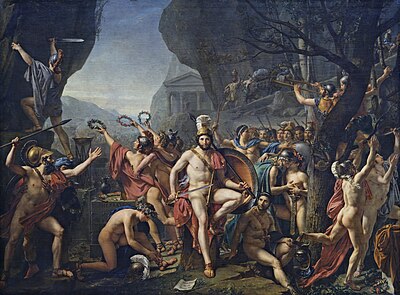
The Battle of Thermopylae was fought in late summer 480 BCE, when the army of the Achaemenid king Xerxes I forced a narrow coastal pass in central Greece. Thermopylae, the 'Hot Gates', took its name from nearby sulphur springs; in antiquity the sea came much closer to the cliffs than it does today, leaving only a thin strip of road. A Greek coalition led by the Spartan king Leonidas held that road for several days while the allied fleet fought the Persian navy off Cape Artemisium to the north-east.
On the third day of fighting, a Persian detachment crossed the mountains by a side path and came down behind the defenders. Most of the Greek force withdrew; Leonidas, his Spartans and several hundred allies stayed and were killed. The road south lay open, and within weeks Persian troops had occupied Athens. The battle became one of the most retold stories in Western culture, yet nearly everything we know about it comes from one Greek author writing two generations later, and no Persian account of it survives.
Why Xerxes invaded Greece: the Persian side
Seen from Persepolis, mainland Greece was a troublesome western edge of an empire that stretched from Egypt to the Indus. The conflict began with the Ionian Revolt of 499–494 BCE, when Greek cities in Anatolia rose against Persian rule and Athens and Eretria sent ships to help; the rebels burned Sardis, a key provincial capital. Darius I's punitive expedition of 490 BCE was checked at Marathon. Xerxes, who came to the throne in 486 BCE, first had to deal with unrest in Egypt and Babylonia before he could return to the unfinished western question.
His preparations were an administrative feat: supply depots along the Thracian coast, a canal cut through the Athos peninsula so that ships could avoid a dangerous cape, and bridges of boats across the Hellespont. Persian envoys had also won over many Greek states before a single battle was fought. Thessaly and much of central Greece submitted, Argos stayed neutral, and Greeks served in Xerxes' army and fleet. The war was therefore not a simple clash of 'East' and 'West'. Xerxes' exact aims are debated; punishing Athens and securing the Aegean frontier are at least as plausible as any plan to rule all of Europe.
Three days at the Hot Gates
According to Herodotus, Xerxes waited four days before attacking, perhaps to coordinate with his fleet. The first assaults were made by Median and Cissian (Elamite) contingents, followed by the royal guard that Greeks called the Immortals, under Hydarnes. In the narrow pass, the bronze armour, large shields and longer spears of the Greek hoplites gave them an advantage over infantry equipped with wicker shields, shorter spears and bows, and Persian numbers counted for little.
During the second night, Hydarnes led a force along a mountain track known as the Anopaea and drove off the Phocian troops guarding it. Herodotus blames a local Greek, Ephialtes, for revealing the path; modern historians note that Persian scouts could well have found it themselves. Warned of the encirclement, most allied contingents left. Those who stayed were the Spartans, about 700 Thespians and 400 Thebans. Leonidas fell in the last fighting, the Thebans surrendered, and the remaining defenders died on a small hill under Persian arrows. Excavations on that hill in 1939 recovered many arrowheads, including types used by Persian archers.
The source problem: reading Herodotus
Herodotus of Halicarnassus, born in a city then under Persian rule, composed his Histories around the 430s and 420s BCE, roughly fifty years after the battle. He relied on oral traditions, monuments and informants with their own agendas, and he openly admits uncertainty at key points, including why Leonidas stayed. No Persian narrative of the campaign exists. Achaemenid royal inscriptions celebrate order, building and the favour of Ahuramazda rather than individual battles; Xerxes' surviving texts list the Ionians among his subject peoples but say nothing about the campaign of 480 BCE.
His numbers are the clearest problem. Herodotus gives Xerxes 1,700,000 infantry and, with the fleet and camp followers, more than five million people, a total no ancient supply system could have fed or watered. Modern estimates of the land army vary widely, but most fall between about 70,000 and 300,000 men, and many scholars prefer the lower half of that range. The Greeks at Thermopylae numbered around 7,000 at the start according to ancient tallies, far more than 'three hundred'.
Yet Herodotus is not a simple propagandist. He praises Persian customs and courage, records Persian versions of events, and was later accused by Plutarch of being a 'friend of barbarians'. His Xerxes, however, is shaped by a moral pattern of pride followed by downfall, and episodes such as the king having the Hellespont whipped read more like tragedy than reporting. Readers should treat his speeches, motives and numbers as interpretation, while his topography and the outline of events are generally more reliable.
Who won the Battle of Thermopylae, and what did it change?
Militarily, Thermopylae was a Persian victory. Xerxes forced the pass at a real but limited cost, Boeotia including Thebes came over to his side, and Athens was evacuated. Persian troops burned the Acropolis, an act both Persians and Greeks could read as retribution for Sardis. The Greek fleet withdrew from Artemisium to the island of Salamis.
The decisive reverses came later, at sea at Salamis in September 480 BCE and on land at Plataea in 479 BCE. Xerxes returned to Asia after Salamis, leaving his general Mardonius in Greece. The empire itself was not shaken: it endured for another century and a half, and Persian diplomacy and silver remained a powerful force in Greek politics, culminating in the King's Peace of 387/386 BCE. Thermopylae's real legacy was as memory. The Spartan defeat became a symbol of sacrifice for freedom, a story Greeks retold for centuries and modern European nationalism later reused.
The film 300: myths versus evidence
Most people today meet Thermopylae through Frank Miller's 1998 comic 300 and Zack Snyder's 2006 film adaptation, which openly favour spectacle over history. The first myth is in the title: the Spartans did not fight alone. Several thousand Greeks held the pass, and the 700 Thespians who stayed to the end are almost erased from popular memory. Spartan citizens were also accompanied by helots, the enslaved population whose labour made Spartan military life possible, which sits awkwardly with the film's speeches about free men facing a slave empire.
The film's Persians are drawn from fantasy. Xerxes appears as a towering, pierced 'god-king', but Achaemenid kings never claimed to be gods; their inscriptions present them as mortal rulers governing 'by the favour of Ahuramazda', and Persepolis reliefs show a robed, bearded monarch. The Immortals were not masked monsters: glazed-brick panels from the palace at Susa depict guardsmen in long patterned robes carrying spears and bows. Ephialtes was not a deformed Spartan outcast, and the famous slogan 'come and take them' is first recorded by Plutarch more than five centuries later.
When the film opened in 2007, Iranian officials publicly condemned it as an insult to Iranian history, and many Iranians in Iran and abroad, across political lines, objected to its portrayal of their ancestors. The reaction shows how ancient battles still shape modern identities. Approached critically, Thermopylae is a story about a brave rearguard action, a large, well-organized multi-ethnic empire, and a historian whose vivid storytelling still frames how both sides are imagined.
Frequently asked questions
Who won the Battle of Thermopylae?
The Persian army of Xerxes I won. After about three days of fighting it outflanked the Greek position, killed Leonidas and the remaining defenders, and advanced to occupy Athens. The Greeks later reversed the campaign at Salamis (480 BCE) and Plataea (479 BCE).
Were there really only 300 Spartans at Thermopylae?
There were 300 Spartan citizen soldiers, but they were part of a Greek force of roughly 7,000 by ancient counts, and they were accompanied by helots. On the final day about 700 Thespians and 400 Thebans also remained alongside the Spartans.
How big was the Persian army at Thermopylae?
Herodotus claims 1.7 million infantry, which is not credible. Modern estimates for Xerxes' entire land army usually range from about 70,000 to 300,000, and only a fraction of it could fight in the narrow pass at any one time.
Is the movie 300 historically accurate?
No. It is a stylized fantasy based on a comic book. It omits the thousands of other Greeks, turns Xerxes into a 'god-king' and the Immortals into monsters, and ignores Sparta's reliance on enslaved helots. Only its basic outline, a Greek last stand at a pass, is close to the sources.
Why did Xerxes invade Greece?
Athens had supported the Ionian Revolt, helped burn Sardis and defeated Darius I's expedition at Marathon in 490 BCE. Punishing Athens and securing the Aegean frontier were likely aims; claims of a plan to conquer all of Europe rest on Greek interpretation.
Key events on the map
- 480 BCE · Battle of Thermopylae
- 480 BCE · Xerxes' Invasion of Greece
- 480 BCE · Battle of Salamis
Guided storylines
- Thermopylae (480 BCE) — Livius.org
- Herodotus vii. Xerxes according to Herodotus — Encyclopaedia Iranica
- Immortals — Encyclopaedia Iranica
- Herodotus, The Histories, Book 7 — Perseus Digital Library, Tufts University
- Iran condemns Hollywood war epic — BBC News