Xerxes I: The Persian King Beyond the Greek Legend
Who was Xerxes I? The Achaemenid king's reign (486–465 BCE), his invasion of Greece, his building at Persepolis, his death, and the myths around him.
 Open the interactive map
Who was Xerxes I?
Xerxes I was the fourth great king of the Achaemenid Persian Empire, ruling from 486 to 465 BCE over lands that stretched from the Aegean and Egypt to Central Asia and the Indus. His Old Persian name, Khshayarsha, is usually understood as ruler over heroes; Xerxes is its Greek form, and the Hebrew Bible knows him as Ahasuerus in the Book of Esther.
He was born around 518 BCE, the son of Darius I and Atossa, a daughter of Cyrus the Great. That double descent mattered. Although Darius had older sons from an earlier marriage, Xerxes was born after his father became king and linked the new line of Darius to the founder of the empire. In an inscription from Persepolis, Xerxes says that Darius made him the greatest after himself, which suggests he was formally designated heir years before his accession.
The early reign: Egypt and Babylon
Xerxes inherited unfinished business. Egypt had revolted in the last years of Darius, and Xerxes restored control there around 484 BCE, placing his brother Achaemenes in charge as satrap. Around the same time, Babylonia rose in rebellion under local claimants, and the revolt was put down. Greek writers later claimed that Xerxes punished Babylon by destroying its great temple and removing the statue of Marduk. Many modern historians doubt the scale of that story, since Babylonian documents show temple life continuing, though Persian control over Babylonian elites clearly tightened.
These campaigns show Xerxes doing what every Achaemenid king had to do: holding together a multi-ethnic empire whose provinces, the satrapies, had their own traditions and ambitions. Seen from Persepolis or Susa, Egypt and Babylon were far more valuable than the cities of mainland Greece.
Xerxes' invasion of Greece in 480 BCE
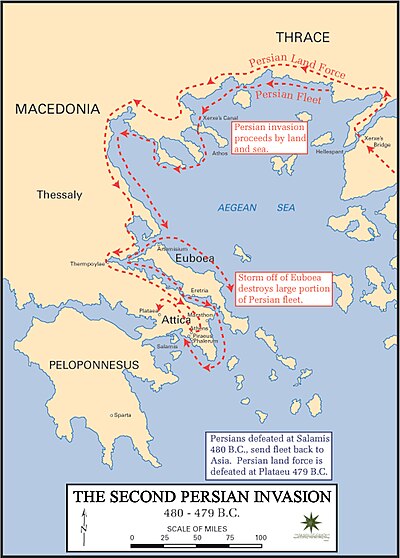
Xerxes is best known in the West for his invasion of Greece, a campaign that continued his father's policy after the Ionian Revolt and the Persian defeat at Marathon in 490 BCE. The preparations were extraordinary: a canal was dug across the Athos peninsula, whose traces archaeologists have confirmed, and boat bridges were laid across the Hellespont. Many Greek states, including Thebes and much of northern Greece, submitted or sided with Persia.
In 480 BCE the Persian army forced the pass at Thermopylae, defeating a Greek force led by the Spartan king Leonidas, then took Athens and burned the Acropolis, a reprisal for the burning of Sardis during the Ionian Revolt. The turning point came at sea, when the allied Greek fleet defeated the Persian navy in the straits of Salamis. Xerxes returned to Asia, leaving his general Mardonius in Greece, and in 479 BCE the Persians were defeated on land at Plataea and at Mycale on the coast of Asia Minor.
Herodotus says Xerxes led more than 1.7 million fighting men, a figure no modern historian accepts; supply and terrain make it impossible, and estimates today usually run from under one hundred thousand to a few hundred thousand. From the Persian side, the defeat was a serious setback on a western frontier, not a collapse: the empire kept its core, its revenues and its prestige for another century and a half, and Persian money would later shape Greek politics more effectively than Persian armies had.
Xerxes the builder and the Daiva inscription
Inside Iran, Xerxes was above all a builder. At Persepolis he completed the Apadana begun by his father, raised the Gate of All Nations with its colossal guardian bulls, built his own palace, the Hadish, and began the Hall of a Hundred Columns. A large share of the royal inscriptions at Persepolis bear his name.
One of them, known as the Daiva inscription, says that among the lands there was a place where daivas, false gods, had been worshipped, and that by the favour of Ahuramazda he destroyed that sanctuary and established the proper worship. Scholars disagree about where this happened and what it means. Some once read it as proof of religious intolerance or as a reference to Babylon or Egypt, while others see a general statement of royal piety in a Zoroastrian-influenced vocabulary rather than a report of a specific event. It sits uneasily beside the tolerant image of Cyrus and is a reminder that Achaemenid religious policy was pragmatic rather than uniform.
The death of Xerxes
In August 465 BCE Xerxes was murdered in a palace conspiracy. Greek accounts name Artabanus, the commander of the royal guard, as the chief plotter, and the details, including the killing of Xerxes' eldest son Darius, differ from writer to writer. A Babylonian astronomical text confirms the timing of the king's death. His younger son Artaxerxes I emerged as king, and Xerxes was buried at Naqsh-e Rostam near Persepolis, in a rock-cut tomb modelled on his father's; the tomb carries no inscription, but its position has led scholars to attribute it to him.
Myth and memory: from Herodotus to 300
Almost everything popular culture knows about Xerxes comes from his enemies. Aeschylus' play The Persians, staged in Athens in 472 BCE, and Herodotus' Histories, written a generation later, turned him into a symbol of arrogance punished by the gods: the king who had the sea whipped when a storm broke his bridge, and who wept over the shortness of human life while reviewing his army. These stories are literature as much as history. Modern films such as 300 push the caricature further, presenting him as a giant, exotic tyrant.
Persian sources tell a different story: a king who speaks in his inscriptions of order, truth, building and his father's legacy, and whose administration kept a vast empire running. The historical Xerxes was neither a monster nor a saint, but a capable ruler who suffered one famous defeat and spent most of his reign governing, building and holding the empire together.
Frequently asked questions
Who was Xerxes in history?
Xerxes I was king of the Achaemenid Persian Empire from 486 to 465 BCE, the son of Darius I and grandson of Cyrus the Great through his mother Atossa. He invaded Greece in 480 BCE and completed major buildings at Persepolis.
Was Xerxes really 8 feet tall?
No. The giant Xerxes is an invention of the film 300 and the comic it was based on. No ancient source describes him as unusually tall; Herodotus only says he was the most handsome and imposing man in his army.
How did Xerxes die?
He was assassinated in August 465 BCE in a court conspiracy that Greek sources attribute mainly to Artabanus, the commander of the royal guard. His son Artaxerxes I succeeded him.
Is Xerxes the king in the Book of Esther?
Most scholars identify Ahasuerus in the Book of Esther with Xerxes I, because the Hebrew name corresponds to the Persian Khshayarsha. Whether the story itself is historical is a separate and much more debated question.
Key events on the map
- 480 BCE · Xerxes' Invasion of Greece
- 480 BCE · Battle of Thermopylae
- 480 BCE · Battle of Salamis
- 440 BCE · Herodotus Writes the Histories
Guided storylines
- XERXES — Encyclopaedia Iranica
- Xerxes I — Livius.org
- XPh: Xerxes' Daiva inscription — Livius.org
- XPf: Xerxes' Harem inscription — Livius.org
- PERSEPOLIS — Encyclopaedia Iranica