The World in 550 BCE: What Was Happening When Cyrus Founded Persia
What was the world like in 550 BCE? Babylon, Lydia, Greece, Egypt, China and India at the moment Cyrus the Great founded the Persian Empire.
 Open the interactive map
The world in 550 BCE: Cyrus overthrows the Medes
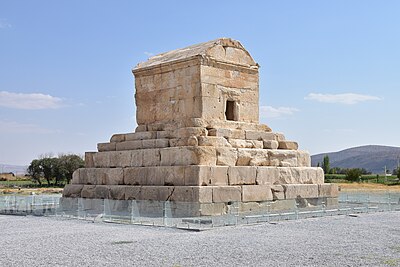
Around 550 BCE, Cyrus, king of Anshan in Pars (today's Fars province in southwestern Iran), defeated his overlord Astyages, king of the Medes, and took the Median capital Ecbatana (Hamadan). The best near-contemporary evidence, a Babylonian chronicle of the reign of Nabonidus, records that Astyages' own army rebelled and handed him over to Cyrus, who then carried silver, gold and other goods from Ecbatana to Anshan. The chronicle places this in Nabonidus' sixth year, 550 or 549 BCE, which is why 550 BCE is the conventional founding date of the Achaemenid Persian Empire.
Herodotus' colourful story of Cyrus' childhood, in which Astyages tries to kill his infant grandson after an ominous dream, belongs to legend rather than history. What matters is that within about eleven years Cyrus would also absorb Lydia and Babylon and build the largest state the world had yet seen. So what was the rest of the world doing in 550 BCE? This page surveys the other major centres of power and thought at that moment, with care about dates that are often uncertain.
Babylon: an absent king
In 550 BCE the Neo-Babylonian Empire was the strongest power in the Near East. It controlled Mesopotamia, Syria and the Levant, and its capital Babylon, rebuilt on a grand scale by Nebuchadnezzar II, was one of the largest cities on earth. Its king, Nabonidus (reigned 556 to 539 BCE), was an unusual ruler. For about ten years he lived at the oasis of Tayma in Arabia, leaving his son Belshazzar in charge at Babylon, and the chronicle repeatedly notes that the New Year festival could not be celebrated properly in his absence.
Nabonidus' devotion to the moon god Sin seems to have made him unpopular with part of the priesthood of Marduk. When Cyrus took Babylon in 539 BCE, Babylonian scribes working for the new king composed the Cyrus Cylinder, which portrays Nabonidus as impious and Cyrus as Marduk's chosen ruler. Historians read this as political messaging rather than neutral reporting. Among Babylon's subjects in 550 BCE were the Judean exiles deported by Nebuchadnezzar, some of whose descendants would later return to Jerusalem under Persian rule.
Lydia and Egypt: wealthy kingdoms on the edge
West of the Medes lay Lydia in western Anatolia, ruled by Croesus from his capital Sardis. The Halys River had marked the Lydian-Median border since a peace traditionally dated to 585 BCE. Lydia was rich in gold from the river Pactolus and is credited with some of the world's earliest coins. Later Greek tradition made Croesus the first ruler to issue separate gold and silver coins, though some of these coins may in fact be early Persian issues.
According to Herodotus, Croesus crossed the Halys to challenge Cyrus, who then took Sardis, probably in the 540s BCE. The exact date is less secure than it once seemed: a line in the Babylonian chronicle for 547 BCE was long read as referring to Lydia, but the name is damaged and many scholars now doubt that reading. Herodotus' tales of Croesus consulting the oracle at Delphi and being saved from a pyre are best read as Greek moral stories.
Egypt was ruled by Amasis (Ahmose II, reigned 570 to 526 BCE) of the Twenty-sixth or Saite Dynasty. He hired Greek mercenaries, gave Greek traders a base at Naukratis in the Nile Delta and, according to Herodotus, allied with Croesus, Babylon and Sparta against Persia. Egypt remained independent until 525 BCE, when Cyrus' son Cambyses conquered it, a year after Amasis died.
Greece in the age of Solon and Peisistratos
Greece in 550 BCE was not a country but hundreds of independent city-states. In Athens, Solon's reforms of the 590s BCE had ended debt slavery and ranked citizens by wealth, but they had not ended political conflict. Peisistratos seized power as tyrant around 561 BCE, was driven out twice, and secured lasting control around 546 BCE; his family ruled until 510 BCE. Athenian democracy was still a generation away, in 508/507 BCE. Sparta, meanwhile, was building the network of alliances later called the Peloponnesian League.
The most dynamic part of the Greek world in 550 BCE was arguably Ionia, on the Aegean coast of Anatolia, where cities such as Miletus traded across the Mediterranean and the Black Sea. Thinkers such as Thales and Anaximander were asking what the world is made of, and Pythagoras was a young man on nearby Samos. The Ionian cities were tributary to Lydia; after Croesus fell they passed under Persian rule, setting the stage for the Ionian Revolt of 499 BCE and the Greco-Persian Wars.
China in the Spring and Autumn period
In China, 550 BCE fell in the Spring and Autumn period (770 to 476 BCE by one common reckoning), named after the chronicle of the state of Lu. The Zhou kings still reigned at Luoyang but held little real power. Large states such as Jin, Chu, Qi and Qin competed for dominance through war, marriage alliances and diplomacy, while the southern state of Wu was beginning to rise. Iron tools and new forms of land taxation were slowly transforming agriculture and government.
Confucius (Kong Qiu) was born in Lu in 551 BCE according to the Han historian Sima Qian, just a year before Cyrus' victory; two early commentaries on the Spring and Autumn Annals give 552 BCE instead. Either way, he was an infant in 550 BCE, and his teaching career belongs to the late sixth and early fifth centuries. Laozi, traditionally an older contemporary, is much harder to date, and many scholars think the Daodejing attributed to him took shape later, by around the fourth century BCE. There was no direct contact between China and Persia at this time; any links ran indirectly through the peoples of the Central Asian steppe.
India: cities, states and new teachers
In the Ganges plain of northern India, the sixth century BCE saw the growth of cities and of rival states, traditionally counted as sixteen mahajanapadas. Kosala and Magadha were among the most powerful; Magadha, under kings such as Bimbisara, would eventually dominate the region and later became the base of the Maurya Empire. Further west, Gandhara, on the edge of the Iranian world, would soon come under Persian rule.
This was also a time of intense religious and philosophical debate, as wandering ascetics questioned Vedic ritual. Two of the most influential teachers were the Buddha and Mahavira, the great teacher of Jainism, and their dates are a classic problem. Older reckonings placed the Buddha around 563 to 483 BCE, which would make him about thirteen in 550 BCE, but many historians now favour a later chronology, with his death around 400 BCE or a little before. Jain tradition dates Mahavira's death to 527 BCE, while many scholars place him later, as a slightly older contemporary of the Buddha. It is therefore possible, but far from certain, that either man was alive when Cyrus came to power.
The Zoroastrian question: what did Cyrus believe?
One of the hardest questions about 550 BCE concerns Zoroaster (Zarathustra) and his teaching. The language of the Gathas, the hymns attributed to him, is very close to that of the Rigveda, which leads many scholars to place him somewhere between about 1500 and 1000 BCE. A later tradition that put him '258 years before Alexander', in the sixth century BCE, is generally regarded as a late and artificial calculation, though a minority of scholars still argue for a later date. On most views, he was not a contemporary of Cyrus.
Whether Cyrus himself followed Zoroaster's teaching is unknown. His surviving inscriptions, chiefly the Cyrus Cylinder, use Babylonian religious language, and none mention Ahuramazda. Darius I, from about 520 BCE, repeatedly credits Ahuramazda with his success but never names Zarathustra. Some Achaemenid family names, such as Vishtaspa (Hystaspes, Darius' father) and Atossa (Cyrus' daughter), echo figures in the Avesta, a suggestive but inconclusive link. The safest summary is that Iranian religious traditions honouring Ahuramazda were present in the early Persian world, while their exact relation to Zoroaster's teaching in 550 BCE remains debated. Our Zoroaster storyline explores what the sources permit.
Frequently asked questions
What happened in 550 BCE?
The best-documented event of 550 BCE is the victory of Cyrus of Anshan over Astyages of Media, recorded in a Babylonian chronicle for 550/549 BCE. It marks the conventional founding of the Achaemenid Persian Empire. At the same time Nabonidus ruled Babylon, Croesus ruled Lydia, Amasis ruled Egypt and Peisistratos was contending for power in Athens.
Were Confucius and Cyrus the Great alive at the same time?
Yes. Confucius was born in 551 or 552 BCE according to the traditional sources, and Cyrus died in 530 BCE, so their lives overlapped by about two decades, although neither is likely to have known of the other.
Were the Buddha and Cyrus the Great contemporaries?
Possibly. On the older chronology (about 563 to 483 BCE) they were; on the later chronology now favoured by many historians, the Buddha was born after Cyrus died. Current evidence cannot settle the question.
Was Cyrus the Great a Zoroastrian?
There is no direct evidence. Cyrus' inscriptions mention neither Ahuramazda nor Zoroaster. Darius I, who came to power in 522 BCE, worshipped Ahuramazda, but how far this reflected Zoroaster's teaching is debated.
What empires existed in 550 BCE?
The main powers were the Median kingdom (overthrown by Cyrus around that year), the Neo-Babylonian Empire, Lydia, Saite Egypt and the rival states of Zhou China, alongside the states of the Ganges plain, the Greek city-states and Carthage in the western Mediterranean.
Key events on the map
- 550 BCE · Founding of Achaemenid Empire
- 599 BCE · Mahavira Establishes Jainism
- 585 BCE · Thales of Miletus — Birth of Greek Philosophy
- 551 BCE · Confucius — Philosopher of Social Harmony
- 546 BCE · Conquest of Lydia
- 539 BCE · Cyrus Enters Babylon
- 528 BCE · Buddha's Enlightenment at Bodh Gaya
Guided storylines
- ABC 7 (Nabonidus Chronicle) — Livius.org
- CYRUS iii. Cyrus II the Great — Encyclopaedia Iranica
- Amasis — Livius.org
- Confucius — Stanford Encyclopedia of Philosophy
- Buddha — Stanford Encyclopedia of Philosophy
- ZOROASTER ii. General Survey — Encyclopaedia Iranica