Iran and India: Shared Roots, Languages and History
Iran and India share deep roots: Indo-Iranian languages, the Avesta and Rigveda, Achaemenid rule on the Indus, Persian at the Mughal court, and the Parsis.
 Open the interactive map
Iran and India: shared roots, separate histories
Iran and India are often described simply as neighbours, but the relationship runs much deeper than geography. The peoples who gave Iran and northern India their oldest languages descended from a common Indo-Iranian community, and for three thousand years armies, merchants, priests, poets and refugees crossed the mountains and seas between them. This comparison traces the shared roots of Iran and India and their main points of contact, from the Avesta and the Rigveda to the Mughal court, the Parsis and Nader Shah's invasion of 1739.
Shared roots do not mean a shared identity. The two regions developed distinct religions, states and literatures, and their contact was often uneven: sometimes peaceful exchange, sometimes conquest. What follows separates well-documented history from later legend and from modern theories that are still debated.
Indo-Iranian languages: the Avesta and the Rigveda
Linguists group Persian, Kurdish, Pashto, Baluchi and the other Iranian languages with Sanskrit, Hindi, Bengali and the other Indo-Aryan languages in a single Indo-Iranian branch of the Indo-European family. The clearest evidence comes from the oldest texts. The Gathas of the Avesta, attributed to Zarathustra, and the hymns of the Rigveda are so close in grammar and vocabulary that whole lines can be converted from one language into the other by applying regular sound changes.
The two traditions also share religious vocabulary. Avestan haoma matches Vedic soma, the sacred plant drink; Avestan asha corresponds to Vedic rta, cosmic order and truth; and the god Mithra appears in the Vedas as Mitra. Some terms moved in opposite directions: daeva became a word for demons in Zoroastrian usage while deva remained 'god' in India, and ahura rose to the highest rank in Iran while asura later came to mean a demon in India. The Iranian sound shift from s to h explains why the river Sindhu became Hindu in Old Persian, the origin of the words Hindu and India.
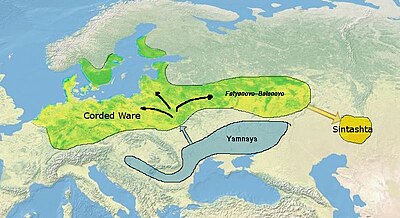
When and where the ancestral community lived remains debated. Many scholars place it in the steppes and oases of Central Asia around the early second millennium BCE, before groups moved south into Iran and the Indian subcontinent. The Rigveda is usually dated roughly 1500 to 1200 BCE; the date of the Gathas is far less certain, and scholarly estimates differ by several centuries.
Hindush: the Achaemenid satrapy on the Indus
The first direct political link recorded in written sources came with the Achaemenid Persian Empire. Gandhara, in today's northern Pakistan, appears among the lands of Darius I in the Behistun inscription of about 520 BCE and may already have been taken under Cyrus. Hindush, the land along the lower Indus, was added soon after, probably around 515 BCE, and appears in Darius' later inscriptions. According to Herodotus, Darius first sent the Greek sea captain Scylax of Caryanda down the Indus to the ocean.
Herodotus also claims that the Indians paid the largest tribute of any people, 360 talents of gold dust a year. His figures are not reliable, but Darius' own foundation inscription at Susa names timber brought from Gandhara and ivory from Hindush, and Indian subjects appear among the throne-bearers carved on the royal tombs at Naqsh-e Rostam. Indian troops served in Xerxes' army in 480 BCE. Achaemenid rule left lasting traces: the Kharosthi script, used in the northwest for centuries, was derived from the Aramaic script, and Aramaic was the administrative language of the Persian empire. Some historians also see Persian influence in the polished stone pillars of the Maurya king Ashoka, although that connection is debated.
Between empires: books, chess and scholars
After Alexander's campaigns and the rise of the Maurya and Seleucid states, contact continued across shifting frontiers. Parthian and Saka rulers held parts of the northwest, and the Kushan empire straddled both worlds. The Sasanian king Shapur I claimed, in his inscription on the Ka'ba-ye Zartosht at Naqsh-e Rostam, that his realm reached as far as Peshawar.
Cultural exchange is easier to trace than political borders. Under Khosrow I in the sixth century, the physician Borzuya is said to have brought the Indian story collection known as the Panchatantra to Iran; its Middle Persian version, through the Arabic Kalila wa Dimna, became one of the most widely translated books of the medieval world. A Middle Persian text tells how chess reached Khosrow's court from India. In the eleventh century the Khwarazmian scholar al-Biruni, who accompanied Mahmud of Ghazni's campaigns, wrote a careful study of Indian science and religion.
Persian as the language of the Mughal court
From the eleventh century, Turkic dynasties steeped in Persian court culture, beginning with the Ghaznavids in Lahore and continuing through the Delhi Sultanate, made Persian the language of government and high literature across much of northern India. Amir Khusraw of Delhi (1253 to 1325) became one of the most admired Persian poets of his age.
The Mughals took this further. Babur, who founded the dynasty in 1526, wrote his memoirs in Chaghatai Turkic, but his son Humayun regained his lost throne with help from the Safavid Shah Tahmasp, and under Akbar (reigned 1556 to 1605) Persian became the administrative language of the whole empire, from imperial decrees to revenue records. Iranian officials, poets, painters and physicians sought careers in India, where patronage was often richer than at the Safavid court. Nur Jahan, the powerful empress of Jahangir, was born to an Iranian family on its way to Mughal service.
Indian writers made Persian their own. The 'Indian style' (sabk-e hendi) of intricate poetry flourished with poets such as Bedil of Delhi, and Persian vocabulary entered Urdu and Hindi on a large scale. Persian remained the official language of the East India Company's courts until 1837, and even afterwards Ghalib and Muhammad Iqbal wrote major works in Persian.
The Parsis: Zoroastrians in India
The Parsis, whose name means 'Persians', descend from Zoroastrians who left Iran for western India in the centuries after the Arab Muslim conquest. Their best-known origin story, the Qissa-i Sanjan, was composed around 1600 and describes refugees landing at Sanjan in Gujarat and receiving permission to settle from a local ruler. Its dates are uncertain and its details partly legendary, so historians see the migration as gradual rather than a single voyage. Our Parsi Beginnings storyline examines this evidence in detail.
Contact with Iran never stopped. Between the fifteenth and eighteenth centuries, Parsi priests sent questions on ritual to Zoroastrian priests in Yazd and Kerman, and the replies were collected as the Persian Rivayats. In the nineteenth century, wealthy Parsis in Bombay funded schools for Iranian Zoroastrians and lobbied the Qajar court, efforts that led to the abolition of the poll tax (jizya) on Zoroastrians in 1882. Later Zoroastrian migrants from Iran, known in India as Iranis, formed a related community. Parsis have played an outsized role in modern Indian industry, law and politics, although the 2011 census counted fewer than 60,000 of them.
Nader Shah's 1739 invasion of India
The most violent encounter of the early modern period came in 1739. Nader Shah, who had driven the Afghans from Iran and taken the crown in 1736, invaded Mughal territory after Delhi sheltered Afghan fugitives and ignored his envoys. At Karnal, north of Delhi, his smaller but battle-hardened army, with its mounted musketeers, defeated the Mughal emperor Muhammad Shah in February 1739.
Nader entered Delhi in March. When rumours of his death led to attacks on Persian soldiers, he ordered a reprisal in which tens of thousands of residents were killed in a single day; contemporary estimates vary widely. He left Muhammad Shah on the throne but annexed the lands west of the Indus and carried off an enormous treasure, including the Peacock Throne and the Koh-i-Noor diamond. The plunder allowed him to remit taxes in Iran for three years. In India the invasion exposed Mughal weakness and helped open the way for Afghan, Maratha and eventually British power, a reminder that the long relationship between Iran and India included conquest as well as exchange.
Frequently asked questions
Are Iranians and Indians related?
Linguistically, in part. The Iranian languages and the Indo-Aryan languages of northern India descend from a common Indo-Iranian ancestor, and the Avesta and Rigveda preserve closely related religious vocabulary. Language is not the same as ancestry, however, and both regions have long and mixed population histories.
What is the connection between the Avesta and the Rigveda?
They are the oldest texts of the Iranian and Indo-Aryan traditions, composed in sister languages. They share divine names, ritual terms such as haoma and soma, and the idea of cosmic truth (asha and rta), although Zoroastrian teaching reshaped much of this inheritance.
Why was Persian spoken in India?
Persian was the language of government and high culture under the Ghaznavids, the Delhi Sultanate and the Mughals. Under Akbar it became the empire's administrative language, and it stayed in official use until the British replaced it in 1837.
Who are the Parsis?
The Parsis are the Zoroastrians of India, descended from migrants who left Iran for Gujarat over several centuries after the Arab conquest; the exact dates are uncertain. Most live today in Mumbai and Gujarat.
What did Nader Shah take from India?
After defeating the Mughals at Karnal in 1739 and occupying Delhi, Nader Shah carried off vast treasure, including Shah Jahan's Peacock Throne and the Koh-i-Noor diamond. The Darya-ye Nur diamond in Iran's national jewel collection is generally believed to come from the same plunder.
Key events on the map
- 1500 BCE · Migration of Indo-Iranian Peoples
- 1500 BCE · Vedic Period and the Rigveda
- 520 BCE · Establishment of the Satrap System
- 550 CE · Borzuya Brings Indian Knowledge to Persia
- 716 CE · Zoroastrian Emigration to India (Parsis)
- 1530 CE · Persian: The Language of Power in India
- 1739 CE · Nader Shah's Invasion of India
- 1850 CE · Parsi Legacy in Modern India
Guided storylines
- INDIA i. Introduction — Encyclopaedia Iranica
- INDO-IRANIAN RELIGION — Encyclopaedia Iranica
- Scylax of Caryanda — Livius.org
- PARSI COMMUNITIES i. Early History — Encyclopaedia Iranica
- NĀDER SHAH — Encyclopaedia Iranica