Nader Shah: The Delhi Campaign of 1739 and the Peacock Throne
Who was Nader Shah? How the Afsharid ruler rose from the Safavid collapse, won at Karnal, sacked Delhi in 1739 and took the Peacock Throne.
 Open the interactive map
Who Was Nader Shah?
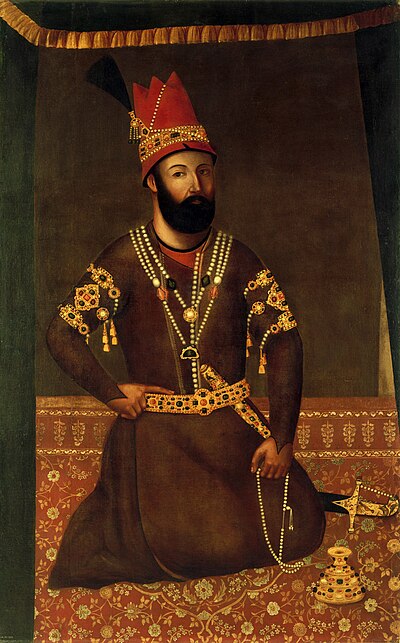
Nader Shah (reigned 1736–1747) was the founder of the Afsharid dynasty and the most formidable military commander in eighteenth-century Asia. Rising from obscurity during the collapse of the Safavid state, he expelled Afghan occupiers from Iran, recovered provinces lost to the Ottomans and Russia, crowned himself shah, and in 1739 marched on Delhi, defeating the Mughal emperor and carrying the Peacock Throne back to Iran. His reign is remembered for spectacular victories, but also for crushing taxation and cruelty that turned much of his own country against him.
He was born around 1688 (the exact date is debated) into the Qirqlu clan of the Turkic-speaking Afshar tribe in northern Khorasan. The official chronicle of his reign by his secretary Mirza Mahdi Khan Astarabadi, later writers and European travellers all shaped his image. Stories of a rise from shepherd to king owe something to literary convention, but he clearly made his career as a soldier and local warlord rather than by inheriting rank.
From the Afghan Invasion to the Throne (1722–1736)
In 1722 Ghilzai Afghan forces under Mahmud Hotak took Isfahan after a long siege, ending effective Safavid rule. The Ottomans and Peter the Great's Russia then seized western and Caspian provinces. A surviving Safavid prince, Tahmasp II, gathered supporters in the north, and in 1726 Nader entered his service, taking the name Tahmasp-qoli Khan, "servant of Tahmasp".
Nader rebuilt the army around disciplined musket-armed infantry, fast cavalry and artillery. In 1729 he defeated the Afghan ruler Ashraf at Mehmandust and Murchekhort and drove the Afghans out of Isfahan. Campaigns against the Ottomans followed, while diplomacy with Russia secured the return of the Caspian provinces through the treaties of Rasht (1732) and Ganja (1735).
Success made the Safavid shah expendable. In 1732 Nader deposed Tahmasp II and placed his infant son on the throne as Abbas III. Early in 1736 he summoned notables to a great assembly on the Moghan plain, where he was proclaimed shah. He asked them to accept a religious settlement: an end to the ritual cursing of the first caliphs and recognition of Twelver Shi'ism as a fifth, "Ja'fari", school of law alongside the four Sunni schools. The policy aimed partly at peace with the Ottomans and at the loyalty of his many Sunni soldiers, but Istanbul never accepted it.
The Delhi Campaign of 1739 and the Battle of Karnal
After taking Kandahar, the last Hotak stronghold, in March 1738, Nader accused the Mughal court of sheltering Afghan fugitives and ignoring his envoys. Historians debate whether this grievance was genuine or a pretext; most see the wealth of Delhi, needed to pay his huge army, as a central motive. He took Ghazni and Kabul in 1738, passed through the Khyber region and advanced through Lahore toward Delhi.
On 24 February 1739 his army met the much larger forces of the Mughal emperor Muhammad Shah at Karnal, north of Delhi. Contemporary troop numbers vary widely and should be treated with caution, but Nader's disciplined musketeers and camel-mounted swivel guns (zamburak) routed the Mughal army within hours. Muhammad Shah submitted, and the two rulers entered Delhi together in March.
On 22 March a rumour that Nader had been killed led to attacks on Persian soldiers in the city. Nader ordered reprisals, and in the massacre that followed thousands of residents died in a single day. Contemporary estimates range from about 20,000 to 30,000 or more; the true number is unknown. Indian writers such as Anand Ram Mukhlis recorded the horror, and the massacre still dominates how Nader is remembered in South Asia.
Nader did not try to rule India. He restored Muhammad Shah to his throne, annexed the lands west of the Indus and left Delhi in May 1739 with an immense treasure. Contemporary valuations are rough and probably inflated, but the haul was large enough for Nader to cancel taxes in Iran for three years.
What Happened to the Peacock Throne?
The most famous prize was the Peacock Throne (Takht-e Tavus), the jewelled throne made for the Mughal emperor Shah Jahan and completed in the 1630s. It was carried to Iran together with celebrated gems, among them the Koh-i-Noor and the Darya-ye Nur diamonds.
The original throne does not survive. It is generally thought to have been broken up or plundered in the turmoil after Nader's murder in 1747. The throne later called the Peacock Throne in Tehran is a different object: the Sun Throne (Takht-e Khorshid) made for the Qajar ruler Fath-Ali Shah, which popularly acquired the Mughal name. The Koh-i-Noor passed to the Afghan ruler Ahmad Shah Durrani, then to the Sikh maharaja Ranjit Singh, and in 1849 to the British, while the Darya-ye Nur remains in Iran's National Jewels collection.
Later Campaigns, Decline and Assassination
After India, Nader campaigned in Central Asia in 1740, forcing Bukhara and Khiva to submit. A long war in Dagestan from 1741 stalled against mountain communities. He fought the Ottomans again from 1743, defeating them near Kars in 1745, and the Treaty of Kerden in 1746 largely confirmed the old frontier without Ottoman acceptance of his religious formula. Unusually for an Iranian ruler, he also built fleets in the Persian Gulf and the Caspian Sea.
After an attempt on his life in 1741 he suspected his eldest son, Reza-qoli Mirza, and had him blinded. Chroniclers and foreign observers describe growing suspicion, brutal punishments and ruinous tax demands, and revolts broke out across Iran. In June 1747, at Fathabad near Quchan in Khorasan, a group of his own officers, including Afshar and Qajar commanders, killed him in his tent.
Legacy: Saviour, Conqueror or Destroyer?
Nader's empire did not outlive him. His relatives fought over Khorasan; Ahmad Shah Durrani, one of his commanders, founded an Afghan state that took Kandahar and the Koh-i-Noor; and western Iran eventually came under Karim Khan Zand. Yet Nader had restored Iranian independence after the Afghan conquest and held back both the Ottomans and Russia.
Judgements remain divided. Nineteenth-century European writers called him the "Napoleon of Persia", a label that says more about European frames of reference than about Nader. Iranian nationalist history often celebrates him as the saviour of the country, while many Indian accounts remember him mainly for the Delhi massacre. Modern historians such as Michael Axworthy stress both his military innovation and the human cost of his wars. His sack of Delhi accelerated, but did not by itself cause, the decline of Mughal central power that later opened space for regional rulers and the British East India Company.
Frequently asked questions
Why did Nader Shah invade India?
Officially, Nader accused the Mughal court of sheltering Afghan fugitives and mistreating his envoys. Most historians think the wealth of Delhi, needed to pay and supply his large army, was the main motive, and that Mughal weakness made the campaign tempting.
What did Nader Shah take from Delhi?
He carried off the Mughal treasury, including the Peacock Throne of Shah Jahan, the Koh-i-Noor and Darya-ye Nur diamonds, jewels, coin and other valuables. Contemporary estimates of the total value vary and are probably exaggerated, but the treasure allowed him to remit Iranian taxes for three years.
Where is the Peacock Throne now?
The original Mughal Peacock Throne is lost; it was probably broken up after Nader's assassination in 1747. The throne shown in Tehran and often called the Peacock Throne is the Qajar-era Sun Throne, a different object.
How did Nader Shah die?
He was assassinated in June 1747 at Fathabad near Quchan in Khorasan by a group of his own officers, who feared his growing suspicion and violence. His empire quickly broke apart after his death.
Key events on the map
- 1739 CE · Nader Shah's Invasion of India
- 1729 CE · Nader Expels the Afghans
- 1736 CE · Coronation of Nader Shah
- 1738 CE · Nader Shah Captures Kandahar
- 1740 CE · Nader Shah's Central Asian Campaign
- 1743 CE · Nader Shah Defeats the Ottomans
- 1747 CE · Assassination of Nader Shah
- Nāder Shah — Encyclopaedia Iranica
- Afsharids — Encyclopaedia Iranica
- India vii. Relations: The Afsharid and Zand Periods — Encyclopaedia Iranica