Parthian Empire: History, Timeline & Map
Parthian (Arsacid) Empire history, c. 247 BCE–224 CE: Mithridates, the Silk Road, Carrhae and the wars with Rome, on an interactive timeline and map.
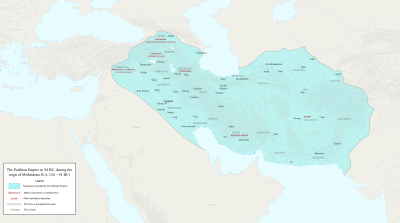 Open the interactive map
What was the Parthian Empire?
The Parthian, or Arsacid, Empire ruled Iran and Mesopotamia for nearly five centuries, from around 247 BCE to 224 CE, longer than any other dynasty of ancient Iran. Its founders, the Parni, were a semi-nomadic Iranian people from the steppe east of the Caspian who took over the Seleucid province of Parthia, in today's northeastern Iran and southern Turkmenistan. The dynasty counted its era from 247 BCE, although the actual seizure of Parthia probably came some years later.
Rise of the Parthians: From Nisa to Ctesiphon
Mithridates I (c. 171–132 BCE) turned a regional kingdom into an empire, taking Media and Mesopotamia and entering Seleucia on the Tigris around 141 BCE. Mithridates II (c. 124–88 BCE; his dates are debated) secured the eastern frontier against nomadic invaders, exchanged envoys with Han China and, through his envoy Orobazus, made the first Parthian diplomatic contact with Rome, meeting Sulla on the Euphrates around 96 BCE. Ctesiphon, across the river from Seleucia, became a principal royal seat.
A Flexible Empire: Nobles, Trade and Culture
Parthian rule was decentralised. Great noble houses such as the Suren and Karen, and vassal kingdoms like Persis, Elymais and Adiabene, kept wide autonomy under the "king of kings". This flexible system let the Arsacids profit from overland trade linking China, India and the Mediterranean. Coins with Greek legends and the title "Philhellene" coexisted with the Parthian language, Zoroastrian, Jewish, Christian and Babylonian traditions, and minstrels whose tales are thought to have fed later Persian epic.
Wars with Rome, Fall and Legacy
In 53 BCE the Parthian general Surena destroyed Crassus's army at Carrhae, and for nearly three centuries Rome and Parthia contested Armenia and Mesopotamia. Roman armies sacked Ctesiphon several times (116, 165 and 198 CE) but never held it for long. Weakened by these wars and by rival claimants to the throne, Artabanus IV was overthrown by Ardashir of Persis in 224 CE. Because most surviving narratives are Roman, and Sasanian tradition played down its predecessors, the Parthians are often under-credited; archaeology at Nisa, Hatra and other sites is slowly correcting the picture.
Timeline of events
247 BCE · Rise of the Parthians
Arsaces I leads the Parni tribe to conquer Parthia from the Seleucids, laying foundations for the Parthian (Arsacid) Empire that would rival Rome. (Parthia) View on map
200 BCE · Nisa: Parthian Royal Residence
The fortified city of Nisa serves as an early Parthian capital and royal necropolis, blending Hellenistic and Iranian architectural styles. (Nisa) View on map
165 BCE · Mithridates I Expands the Empire
Mithridates I conquers Media, Elymais, and Mesopotamia from the Seleucids, transforming Parthia into a major empire stretching from the Euphrates to eastern Iran. (Seleucia-Ctesiphon) View on map
150 BCE · Parthian Art: The Rhyton Tradition
Parthian artisans create elaborate ivory and horn rhytons (drinking vessels) blending Hellenistic and Iranian artistic traditions, found at Nisa and other sites. (Nisa) View on map
141 BCE · Parthians Capture Seleucia
Mithridates I captures the Seleucid capital Seleucia on the Tigris, establishing nearby Ctesiphon as the Parthian winter capital. (Ctesiphon) View on map
124 BCE · Reign of Mithridates II the Great
Mithridates II extends Parthia to its greatest extent, takes the title 'King of Kings', and establishes first diplomatic contact with Rome and Han China. (Ctesiphon) View on map
120 BCE · Parthians Control the Silk Road
The Parthian Empire becomes the crucial middleman in Silk Road trade between China's Han dynasty and the Roman Empire, growing enormously wealthy. (Nisa (Turkmenistan)) View on map
53 BCE · Battle of Carrhae
Decisive Parthian victory over the Roman Republic. General Surena annihilates seven Roman legions under Crassus using the famous 'Parthian shot' cavalry tactics. (Carrhae (Harran)) View on map
53 BCE · Capture of Roman Eagle Standards
The Parthians capture the Roman legion eagle standards at Carrhae, a profound humiliation for Rome. The standards are later returned under Augustus. (Carrhae) View on map
40 BCE · Parthian Invasion of Roman Syria
Pacorus I and General Barzapharnes invade Roman territories, briefly conquering Syria and Judea during the Roman civil wars. (Syria) View on map
36 BCE · Mark Antony's Parthian Campaign
Roman triumvir Mark Antony invades Parthian territory with 100,000 troops, attempting to avenge Crassus's defeat at Carrhae. The campaign fails disastrously — Antony loses his siege train, is harassed by Parthian cavalry during a grueling winter retreat through Armenia, and loses roughly a third of his army. (Phraaspa (near Tabriz)) View on map
2 BCE · Musa of Parthia
Musa (known as Thea Musa) was a Roman slave sent as a gift to the court of the Parthian King Phraates IV. She rose to prominence, becoming his favorite queen, and bore him a son, Phraates V. After poisoning her husband, she ascended to the throne alongside her son. Their joint reign lasted for six years before they were ousted by Parthian nobles and fled to Rome. Musa is historically significant as one of only three female rulers in Iranian history and the first to have her portrait minted on coins (Ctesiphon) View on map
1 CE · The Magi and Early Christianity
The 'Magi from the East' in Christian tradition are widely identified as Zoroastrian priests from Persia, connecting Iranian religious tradition to the birth of Christianity. (Bethlehem) View on map
50 CE · Spread of Christianity in Parthian Empire
According to tradition, the Apostle Thomas travels through the Parthian Empire to spread Christianity, reaching as far as India. Christianity takes root in Mesopotamia. (Ctesiphon) View on map
100 CE · Hatra Flourishes as Parthian City
The fortified city of Hatra in Mesopotamia flourishes as a major religious and trading center, successfully resisting multiple Roman sieges. (Hatra) View on map
116 CE · Trajan's Invasion of Parthia
Roman Emperor Trajan invades Parthia, briefly capturing Ctesiphon and reaching the Persian Gulf — the furthest east Rome ever reached. (Ctesiphon) View on map
165 CE · Parthian-Roman War under Vologases IV
Vologases IV fights against Roman Emperor Marcus Aurelius. Rome sacks Ctesiphon but Parthia retains independence. (Ctesiphon) View on map
217 CE · Battle of Nisibis (217 CE)
Artabanus IV of Parthia defeats the Roman Emperor Macrinus near Nisibis in one of the last major Parthian–Roman battles. The three-day engagement ends with a Roman retreat and a peace treaty requiring Rome to pay 200 million sesterces — the last great Parthian military victory before the dynasty's fall to the Sasanians. (Nisibis (Nusaybin, Turkey)) View on map
224 CE · Fall of the Parthian Empire
The last Parthian king Artabanus V is defeated by Ardashir I of the Sasanian dynasty at the Battle of Hormozdgan, ending 470 years of Arsacid rule. (Hormozdgan (near Firuzabad)) View on map
Frequently asked questions
Who won the Battle of Carrhae?
The Parthians did. In 53 BCE a Parthian army led by Surena, built around horse archers and armoured cavalry, defeated the Roman general Marcus Licinius Crassus near Carrhae (Harran, in today's southeastern Turkey). Crassus was killed and Roman legionary standards were captured.
How long did the Parthian Empire last?
About 470 years, from around 247 BCE to 224 CE, making the Arsacids the longest-ruling dynasty of ancient Iran.
Were the Parthians Persians?
They were Iranian, but not Persian in the narrow sense. The Persians came from Pars in the southwest, while the Parthians took their name from Parthia in the northeast and spoke Parthian, a northwestern Iranian language related to but distinct from Middle Persian.
Key events on the map
- 247 BCE · Rise of the Parthians
- 165 BCE · Mithridates I Expands the Empire
- 120 BCE · Parthians Control the Silk Road
- 53 BCE · Battle of Carrhae
- 224 CE · Fall of the Parthian Empire
Guided storylines
- Arsacids — Encyclopaedia Iranica
- Parthia — Livius.org
- Parthian Empire — World History Encyclopedia