Rumi: Life, Poetry and Legacy of the Persian Sufi Poet
Who was Rumi? The Persian Sufi poet's journey from Balkh to Konya, his bond with Shams of Tabriz, the Masnavi, and how translations reshaped him.
 Open the interactive map
Who was Rumi?
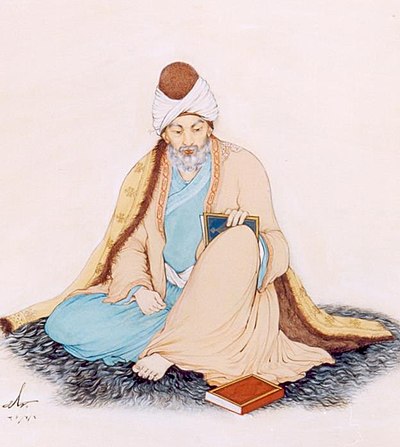
Rumi, born Jalal al-Din Muhammad in 1207 and known in Iran and Afghanistan as Mowlana or Mowlavi, was a Persian poet, Islamic jurist and Sufi teacher who spent most of his life in Konya, in today's Turkey. The name Rumi means 'from Rum', the Muslim term for Anatolia, the former Roman and Byzantine land where he settled. He wrote overwhelmingly in Persian, and his two great works, the lyric Divan-e Shams and the six-book Masnavi, are pillars of Persian literature.
Today Afghanistan, Tajikistan, Iran and Turkey all claim Rumi, through his birthplace, his language and culture, or his tomb and the Mevlevi order. Rather than choose among them, it helps to see him as part of a Persian-speaking world of scholars who moved across the eastern Islamic lands in the early thirteenth century, a world the Mongol invasions were about to shatter.
From Balkh to Konya: Rumi's early life
Rumi was born in the Balkh region of Khorasan; the scholar Franklin Lewis argues more precisely for Vakhsh, in present-day Tajikistan, where his father taught. That father, Baha al-Din Walad, was a preacher and theologian whose mystical notebooks, the Ma'aref, later shaped his son. Around 1216 to 1220 the family left the region. Later biographers said they fled the approaching Mongols or a quarrel with the Khwarazmshah, but the real reasons are uncertain. A famous story in which the boy meets the poet Attar in Nishapur comes from later hagiography and has no contemporary support.
After a pilgrimage and years of travel, the family lived in Larende (Karaman), where Rumi married and his son Sultan Walad was born in 1226. Around 1229 they settled in Konya, capital of the Seljuk sultanate of Rum. When Baha al-Din died in 1231, Rumi succeeded him as teacher, trained further under his father's disciple Burhan al-Din of Termez, and studied in Aleppo and Damascus. By his late thirties he was a respected jurist and preacher, not yet a poet.
Shams of Tabriz and the birth of a poet
In late 1244 a wandering dervish named Shams al-Din of Tabriz arrived in Konya. Rumi became so absorbed in their companionship that he withdrew from his students, who grew resentful. Shams left for Damascus around 1246; Sultan Walad brought him back, and about a year later he disappeared for good. A later story that Rumi's disciples, even one of his sons, murdered him appears only in sources written long afterwards and is doubted by many scholars.
The loss of Shams turned Rumi into a poet. He composed lyric poems in a state of longing, often signing them with Shams's name instead of his own, which is why the collection is called the Divan-e Shams-e Tabrizi, or the Great Divan. In the standard modern edition it holds more than 3,000 ghazals and close to 2,000 quatrains, many composed amid music and sama, the Sufi practice of listening and movement. Later companions, the goldsmith Salah al-Din Zarkub and the disciple Husam al-Din Chalabi, took Shams's place as his spiritual partners.
The Masnavi: Rumi's masterwork
At Husam al-Din's urging, Rumi began dictating the Masnavi-ye Ma'navi, the 'Spiritual Couplets', around the early 1260s and worked on it until his death. Its six books contain roughly 25,000 rhyming couplets, building on the mystical narrative poems of Sanai and Attar. It opens with the lament of a reed cut from its reed bed, an image of the soul separated from its source. Folk tales, Quranic commentary, sayings of the Prophet, jokes and philosophical argument flow into one another, and a famous line attributed to the poet Jami calls it 'the Quran in the Persian tongue'.
Rumi also left prose: Fihi ma fihi, a collection of his talks; Majales-e Sab'a, seven sermons; and his letters. He died in Konya on 17 December 1273. His fourteenth-century hagiographer Aflaki says Christians and Jews joined Muslims in mourning him, a detail meant to show his universal appeal. Followers mark the anniversary as Sheb-i Arus, the 'wedding night' of the soul's union with God.
The Mevlevi order and the whirling dervishes
Rumi did not establish a formal Sufi order himself. His son Sultan Walad and grandson Ulu Arif Chelebi organised his followers into the Mevlevi order, which spread across Anatolia and later the Ottoman Empire. The sema ceremony, in which dervishes in white robes turn to music as a form of remembrance of God, was elaborated and codified over the following centuries. UNESCO proclaimed the Mevlevi Sema Ceremony a masterpiece of intangible heritage in 2005 and inscribed it on its Representative List in 2008, on Turkey's nomination.
When the Turkish Republic closed Sufi lodges in 1925, Rumi's lodge and tomb in Konya became a museum, now known as the Mevlana Museum. It remains one of the most visited sites in Turkey, and every December the anniversary of his death draws pilgrims and visitors from around the world.
Rumi in translation: popularity and debate
For centuries Rumi was read and commented on across the Persian, Ottoman and South Asian worlds; the Masnavi was taught in Ottoman lodges and Indian madrasas, and the poet-philosopher Muhammad Iqbal called Rumi his guide. Scholarly English translation began in earnest with Reynold Nicholson, who edited and translated the Masnavi between 1925 and 1940, and continued with A. J. Arberry and others.
Since the 1990s Coleman Barks's free English versions have made Rumi a publishing phenomenon, and he is often described as the best-selling poet in the United States, a claim widely repeated but hard to measure. Barks does not read Persian; he reworked earlier scholarly translations. Critics, including the writer Rozina Ali in The New Yorker, argue that popular versions strip out the Quranic references and Islamic framework that are central to the poems, and many viral 'Rumi quotes' cannot be traced to his works at all. Reading a scholarly translation alongside the popular ones is the surest way to meet the poet himself.
Frequently asked questions
Was Rumi Persian or Turkish?
Rumi was born in the Persian-speaking Balkh region of Khorasan and wrote almost entirely in Persian, with some Arabic and a few lines in Turkish and Greek. He lived and is buried in Konya, in today's Turkey. Modern national labels fit the thirteenth century poorly; he belongs to a shared Persianate culture.
What is the Masnavi about?
The Masnavi is a six-book mystical poem of about 25,000 couplets that teaches through stories, Quranic interpretation and reflection. Its central theme is the soul's longing to return to God, introduced by the opening song of the reed.
Who was Shams of Tabriz?
Shams al-Din of Tabriz was a wandering dervish who met Rumi in Konya in 1244 and transformed him from a jurist and preacher into an ecstatic poet. He vanished around 1247; stories that he was murdered come from later sources and are uncertain.
Where is Rumi buried?
Rumi is buried in Konya, Turkey, beneath the green-tiled dome of his former lodge, which is now the Mevlana Museum.
Are popular Rumi quotes real?
Many are loose modern paraphrases, and some cannot be found in his works at all. Even genuine passages often reach English readers through free versions that drop their Islamic references, so it is worth checking a scholarly translation.
Key events on the map
- 1250 CE · Rumi: Greatest Sufi Poet
- 1177 CE · Attar of Nishapur: Mystic Poet
- 1219 CE · Mongol Invasion of Iran
- 1258 CE · Saadi of Shiraz
- 1370 CE · Hafez of Shiraz
Guided storylines
- Rumi, Jalāl-al-Din — Encyclopaedia Iranica
- Mevlevi Sema ceremony — UNESCO Intangible Cultural Heritage
- The Erasure of Islam from the Poetry of Rumi — The New Yorker