Battle of Carrhae (53 BCE): How Surena Defeated Crassus
The Battle of Carrhae, 53 BCE: how the Parthian general Surena destroyed Crassus' Roman army, why it happened and what the sources really tell us.
 Open the interactive map
What was the Battle of Carrhae?
The Battle of Carrhae was fought in 53 BCE near the town of Carrhae, ancient Harran in today's south-eastern Turkey, between a Roman army under Marcus Licinius Crassus and a Parthian force commanded by the nobleman known to Greek and Roman writers as Surena. It ended in one of the worst defeats in Roman history: Crassus, his son Publius and most of an army of about seven legions were killed or captured. For the Arsacid (Parthian) kingdom, it confirmed that Iran could face Rome as an equal power.
Iranian sources say almost nothing about the battle. The detailed story comes mainly from Plutarch's Life of Crassus, written roughly 150 years later, and from the Roman historian Cassius Dio, writing in the early third century CE. These authors wanted to explain a Roman disaster, so their accounts mix good information with moralising about Crassus's greed and exotic portraits of the enemy. Read carefully, they still reveal a well-planned Parthian campaign.
Why Crassus invaded Parthia
Crassus was the richest man in Rome and a member of the informal alliance with Pompey and Julius Caesar known as the First Triumvirate. His partners had won great military glory; he had not. As governor of Syria from 54 BCE, he planned a war against Parthia without any clear provocation, apparently hoping for fame and plunder. Parthia was then ruled by Orodes II, who had recently won a civil war against his brother Mithridates.
The Armenian king Artavasdes II advised Crassus to advance through the hills of Armenia, where cavalry would be less effective. Crassus chose the more direct route across the open plains of northern Mesopotamia. Orodes answered with a two-front strategy: he led the main royal army into Armenia to keep Artavasdes out of the war, and he sent Surena with a smaller, mobile force to deal with the Romans.
Who was Surena?
'Surena' is a Greek and Latin rendering of Suren, the name of one of the great noble houses of the Parthian realm, which probably held lands in Sistan (Sakastan) in the east. Plutarch describes the commander as not yet thirty, tall and handsome, second only to the king in wealth and honour, and holding his family's hereditary privilege of crowning the Parthian king. He says Surena travelled with a thousand baggage camels and thousands of retainers, details meant to impress Roman readers but also consistent with the power of the great Parthian clans.
His personal name is not recorded. What matters is that Orodes entrusted an independent army to a magnate from an eastern house, which reflects the decentralized, aristocratic structure of the Arsacid state. That structure is often treated as a weakness, yet at Carrhae it supplied a professional cavalry force drawn from the household troops of one noble family.
How the battle was fought
Modern reconstructions usually put Surena's army at about 10,000 cavalry: roughly 1,000 heavily armoured cataphracts, with horse and rider protected by mail or scale, and some 9,000 mounted archers. Against them Crassus led roughly 35,000 to 40,000 men, mostly legionary infantry, with limited cavalry that included Gallic horsemen brought by Publius. Plutarch claims an Arab chieftain deliberately led the Romans away from water and cover, a story that conveniently shifts blame away from Crassus.
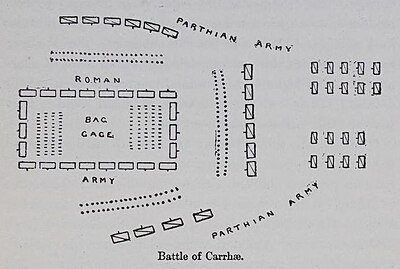
When the armies met near the Balikh River, the Parthians first spread fear with the noise of their drums and then revealed their armour. Crassus formed a large square. The horse archers rode around it, shooting with powerful composite bows; whenever the Romans charged, the archers fell back, often turning in the saddle to shoot behind them, the move later remembered as the 'Parthian shot'. The Romans hoped the arrows would run out, but Surena had organized a train of camels carrying fresh supplies, the real logistical secret of the day.
Publius Crassus led a breakout with cavalry and light troops, was drawn away by a feigned retreat, surrounded by cataphracts and killed. The Parthians displayed his head before his father's lines. At nightfall the Roman army abandoned thousands of wounded men and fled to Carrhae.
The death of Crassus and the aftermath
From Carrhae the survivors tried to escape north towards the Armenian hills. Surena offered a parley, and Crassus, pressed by his mutinous soldiers, went to meet him. A scuffle broke out and Crassus was killed; whether the Parthians intended treachery or the meeting simply collapsed into violence cannot be known. According to Plutarch, about 20,000 Romans died and 10,000 were taken prisoner. Later writers claimed that the Parthians poured molten gold into Crassus's mouth to mock his greed, a story best treated as legend.
Plutarch adds a striking scene: Crassus's head reached the Armenian court, where Orodes and Artavasdes had just made peace, during a performance of Euripides' Bacchae, a reminder that the Parthian elite knew Greek culture well. Surena did not enjoy his triumph for long. Plutarch says Orodes had him put to death soon afterwards, apparently out of jealousy of his prestige. The Roman prisoners were reportedly settled at Merv in the east, while the captured eagle standards became a lasting humiliation for Rome.
Why the Battle of Carrhae mattered
Carrhae made the Euphrates the practical frontier between Rome and Iran for generations and opened nearly three centuries of Roman–Parthian rivalry, later continued by the Sasanians. Mark Antony's invasion of 36 BCE also ended in a costly retreat. Rome recovered the lost standards only in 20 BCE, through diplomacy with the Parthian king Phraates IV rather than war, and Augustus advertised the event on coins and on the breastplate of his famous Prima Porta statue.
In Rome, Crassus's death removed the third partner who had balanced Pompey and Caesar, one of several factors behind the civil war that began in 49 BCE. Popular legend has also linked Carrhae to a 'lost Roman legion' that supposedly reached China and settled at Liqian; this idea, proposed in the 1950s, is not supported by archaeological or genetic evidence. Seen from Iran, Carrhae is best remembered not as an ambush in the desert but as a victory of planning, mobile cavalry and supply, won by a Parthian state that Roman writers too often reduced to stereotypes.
Frequently asked questions
Who won the Battle of Carrhae?
The Parthian (Arsacid) army commanded by Surena won a crushing victory over the Roman army of Marcus Licinius Crassus in 53 BCE. Crassus and his son Publius were killed, and most of the Roman army was killed or captured.
Why did the Romans lose at Carrhae?
Crassus fought on open ground against an all-cavalry army he could neither catch nor outlast. Surena combined armoured cataphracts with horse archers and kept them supplied with arrows by camel train, while the Romans had too little cavalry and few missile troops.
What is the Parthian shot?
It is the tactic of a mounted archer who rides away from the enemy while turning to shoot backwards. Roman writers associated it closely with the Parthians after Carrhae, and the English phrase 'parting shot' is often thought to derive from it.
What happened to the Roman prisoners and eagles from Carrhae?
Pliny the Elder reports that captives were settled at Merv in Margiana. The legionary eagles stayed in Parthia until 20 BCE, when Phraates IV returned them to Augustus through diplomacy. Claims that the prisoners founded a Roman town in China are unproven.
Key events on the map
- 53 BCE · Battle of Carrhae
- 53 BCE · Battle of Carrhae (Roman Defeat)
- 53 BCE · Capture of Roman Eagle Standards
- 36 BCE · Mark Antony's Parthian Campaign
Guided storylines
- Carrhae — Encyclopaedia Iranica
- Carrhae (53 BCE) — Livius.org
- Surena — Livius.org
- Plutarch, Life of Crassus (Loeb translation) — LacusCurtius, University of Chicago