Nowruz: History, Origins and Traditions of the Persian New Year
Nowruz history explained: what the evidence says about its origins, how Haft-sin and Chaharshanbe Suri developed, and why UNESCO lists it.
 Open the interactive map
What is Nowruz? The Persian New Year in brief
Nowruz, Persian for 'new day', is the Iranian New Year, celebrated at the moment of the spring equinox, usually on 20 or 21 March. The history of Nowruz runs through several religions and many states: it was a major feast of the Zoroastrian calendar, it survived the Arab conquest and the spread of Islam, it was re-anchored to the equinox by medieval astronomers, and today it is celebrated across Iran, Afghanistan, Central Asia, the Caucasus, Kurdish regions, South Asia and a worldwide diaspora.
Few festivals attract as many confident claims. Popular articles often state that Nowruz is exactly 3,000 years old or that it was founded by the legendary king Jamshid. This page separates what the sources show from what tradition tells, without dismissing either. A festival does not need a precise birthday to be ancient, and its legends are part of its history too.
Origins of Nowruz: tradition versus evidence
Tradition gives Nowruz a royal founder. In Ferdowsi's Shahnameh, completed around 1010, Jamshid orders the world and has a jewelled throne raised into the sky by demons; the people gather in wonder and call that day the new day. Al-Biruni, writing in the early eleventh century, records this and other origin stories. These accounts were written down in the Islamic period and draw on much older lore about Yima, the first king of Iranian myth, but they explain how Iranians understood the festival, not when it began.
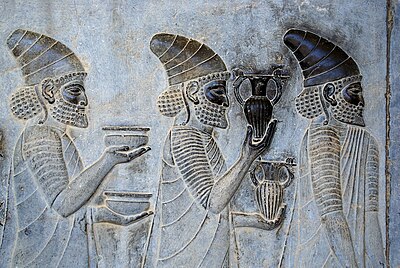
The evidence is thinner. The widely repeated figure of 3,000 years, found even on official United Nations pages, is an estimate tied to the uncertain dating of Zoroaster and the general antiquity of spring festivals, not a documented date. No Achaemenid inscription or administrative tablet names a New Year festival. Some scholars, notably A. Shapur Shahbazi, argued that Persepolis served as a stage for New Year ceremonies and read the Apadana reliefs of gift-bearing delegations in that light; others see the reliefs as an idealised image of imperial order. The idea is plausible but unproven.
Firmer ground comes with the Zoroastrian calendar of the Sasanian era (224 to 651 CE). Middle Persian texts and early Islamic writers describe Nowruz as the first day of the month Frawardin, connected with the renewal of creation and with the end-of-year rites for the fravashis, the guardian spirits of the dead. Because that calendar had 365 days and no leap years, its New Year slowly drifted through the seasons, so Sasanian Nowruz was not reliably tied to spring. Al-Biruni also distinguished a lesser Nowruz on the first of the month from a greater Nowruz on the sixth.
How Nowruz survived and found the equinox
Nowruz did not vanish after the Arab conquest of the seventh century. Umayyad and Abbasid authorities accepted Nowruz gifts, and the solar year remained essential for agriculture and the land tax, so administrators repeatedly adjusted the fiscal New Year as the old calendar drifted. Persian poets such as Manuchehri celebrated the festival in court poetry, and Iranian dynasties like the Samanids and Buyids kept its ceremonies alive.
The decisive change came in 1079 under the Seljuk sultan Malik-Shah and his vizier Nizam al-Mulk, when a group of astronomers that included Omar Khayyam produced the Jalali calendar. It fixed the start of the year to the vernal equinox, binding Nowruz permanently to the first day of spring. Iran's official solar calendar, adopted by law in 1925, descends from this reform, and the exact moment of the equinox, the sal-tahvil, is still announced to the second.
Haft-sin: the Nowruz table and its history
The best-known Nowruz custom today is the haft-sin, a spread of seven items whose Persian names begin with the letter sin. A common set is sabzeh (sprouted greens), samanu (sweet wheat pudding), senjed (oleaster fruit), sir (garlic), sib (apple), somaq (sumac) and serkeh (vinegar), often joined by a mirror, candles, painted eggs, coins, hyacinth, goldfish and a book such as the Quran, the Divan of Hafez or the Shahnameh. Families gather around it at the moment the year turns.
Its documented history is shorter than its symbolism suggests. Early Islamic writers describing older court custom mention gifts, water rites and seeds sown to sprout before the New Year, which may be the oldest layer of the table. The haft-sin in its familiar form, however, is not described in medieval accounts and seems to have taken shape in relatively recent centuries, with the list varying by region and family. The popular claim that it was originally a haft-shin of seven items beginning with sh, including wine, has no early textual support.
Chaharshanbe Suri, Sizdah Bedar and the Nowruz season
Nowruz is a season rather than a single day. Preparations begin with khaneh-tekani, a thorough house cleaning, and new clothes. On the eve of the last Wednesday of the year, Chaharshanbe Suri, people light bonfires and leap over them, singing 'my yellowness to you, your redness to me', handing pallor and illness to the fire and taking its warmth. Customs include qashoq-zani, in which veiled visitors bang spoons on doors for treats, and fal-gush, seeking omens by eavesdropping on passers-by.
The fire rites are probably old; scholars often connect them with the fires lit at the end of the Zoroastrian year to welcome the returning fravashis. The Wednesday cannot be equally ancient, because the seven-day week and the belief that the last Wednesday of the year is unlucky entered Iranian culture in the Islamic period. Chaharshanbe Suri is therefore a layered custom, an older practice attached to a later calendar, rather than a ritual preserved unchanged.
The holidays close on the thirteenth day of the year, Sizdah Bedar, when families spend the day outdoors and cast the sprouted sabzeh into running water to carry away misfortune. In between come visits to elders and relatives, called did-o-bazdid, and eidi, gifts of crisp banknotes for children.
Nowruz beyond Iran and the UNESCO listing
Nowruz belongs to the whole Iranian cultural world and beyond. Afghans, Tajiks, Kurds, Azerbaijanis, Uzbeks, Kazakhs, Kyrgyz and Turkmens celebrate it with their own foods, games and music, such as the sumalak wheat pudding of Central Asia. Kurdish Newroz is tied to the legend of Kaveh the blacksmith and has become a symbol of Kurdish identity. In India, Parsi Zoroastrians mark Jamshedi Navroz, and Baha'is observe Naw-Ruz as a holy day.
In 2009 UNESCO inscribed Nowruz on the Representative List of the Intangible Cultural Heritage of Humanity, nominated jointly by Azerbaijan, India, Iran, Kyrgyzstan, Pakistan, Turkey and Uzbekistan. The listing was extended in 2016 to include Afghanistan, Iraq, Kazakhstan, Tajikistan and Turkmenistan, and again in 2024 to include Mongolia. In 2010 the UN General Assembly also recognised 21 March as the International Day of Nowruz.
The honest history of Nowruz is no less impressive than its myths. We cannot date the first Nowruz, and we cannot prove that Darius celebrated it at Persepolis. We can trace a festival documented for well over a thousand years, rooted in Zoroastrian ideas older still, carried through the Islamic centuries, fixed to the equinox by Seljuk-era astronomers and reinvented by every family that sets a table in March.
Frequently asked questions
How old is Nowruz?
No one can give an exact age. The often-quoted 3,000 years is an estimate, not a documented date. Nowruz is clearly attested as the Zoroastrian New Year in the Sasanian period (224 to 651 CE) and is probably older, but no Achaemenid text names it.
What are the 7 items of Haft-sin?
A common set is sabzeh (sprouts), samanu (wheat pudding), senjed (oleaster), sir (garlic), sib (apple), somaq (sumac) and serkeh (vinegar). The exact list varies, and many families add a mirror, candles, coins, painted eggs, hyacinth and a book.
What is Chaharshanbe Suri?
It is the fire festival held on the eve of the last Wednesday before Nowruz, when people jump over bonfires to leave illness behind. Its fire rites are probably pre-Islamic, but its link to Wednesday dates from the Islamic period.
Did King Jamshid start Nowruz?
That is a legend, best known from Ferdowsi's Shahnameh and medieval writers such as al-Biruni. Jamshid is a mythic figure, so the story explains the festival's meaning rather than its historical origin.
Is Nowruz a religious holiday?
It began as a Zoroastrian sacred day, but today it is largely a cultural celebration shared by Muslims, Zoroastrians, Christians, Jews, Baha'is and secular people. Its date is set by astronomy, at the spring equinox.
Key events on the map
- 518 BCE · Construction of Persepolis Begins
- 716 CE · Zoroastrian Emigration to India (Parsis)
- 1010 CE · Completion of Shahnameh
- 1070 CE · Omar Khayyam: Poet, Mathematician, Astronomer
Guided storylines
- Nowruz i. In the Pre-Islamic Period — Encyclopaedia Iranica
- Nowruz ii. In the Islamic Period — Encyclopaedia Iranica
- Haft Sin — Encyclopaedia Iranica
- Čahāršanba-sūrī — Encyclopaedia Iranica
- Nawrouz, Novruz, Nowrouz, Nowruz, Navruz, Nevruz (Representative List) — UNESCO Intangible Cultural Heritage
- International Day of Nowruz — United Nations