Battle of Chaldiran (1514): Safavids vs Ottomans
The Battle of Chaldiran (1514): why Shah Ismail I and Sultan Selim I went to war, how Ottoman guns won, and how it shaped the Iran–Turkey frontier.
 Open the interactive map
What was the Battle of Chaldiran?
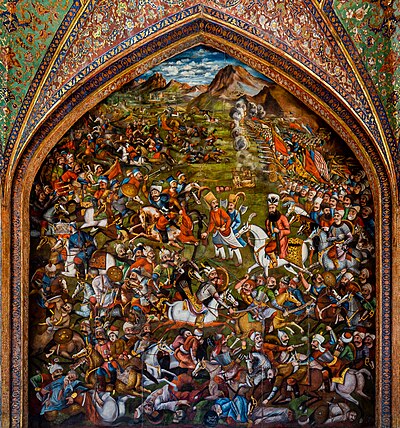
The Battle of Chaldiran was fought on 23 August 1514 on the plain of Chaldiran, north-west of Khoy in today's West Azerbaijan province of Iran. An Ottoman army led by Sultan Selim I defeated the Safavid forces of Shah Ismail I, the young founder of the Safavid state. It was the first great clash between the two empires that would dominate western Asia for the next two centuries, and the first major defeat of a ruler whose followers had believed him invincible.
Chaldiran is often reduced to a simple story of guns beating swords, or of Sunni against Shi'i. The reality was more complex. It grew out of competition for the loyalty of the Turkmen tribes of Anatolia, a disputed Ottoman succession, and two rulers who each claimed universal authority. Its outcome did not end the Safavid state, but it set limits to it and shaped a frontier that still echoes in the map of the region.
Why did Selim I and Shah Ismail go to war?
In 1501 Ismail, the teenage head of the Safavid Sufi order of Ardabil, took Tabriz, crowned himself shah and proclaimed Twelver Shi'ism the religion of his state. His core army, the Qizilbash, came largely from Turkmen tribes, and many of their kinsmen still lived in Ottoman Anatolia, where they revered Ismail as a spiritual guide. For the Ottomans this was a direct threat: a rival ruler commanded religious devotion among their own subjects. In 1511 a large pro-Safavid uprising, the Shahkulu revolt, shook Anatolia.
Ottoman politics sharpened the crisis. Selim forced his father Bayezid II from the throne in 1512 and then defeated and executed his brothers. One of his nephews, Prince Murad, fled to Ismail's court. Selim moved against suspected Qizilbash sympathisers in Anatolia; later Ottoman sources speak of tens of thousands killed or imprisoned, a figure that cannot be verified but reflects a brutal campaign of repression. Ottoman jurists issued opinions declaring the Qizilbash heretics, which made war against them religiously lawful.
Insulting letters passed between the rulers, preserved in later collections whose wording may have been polished. Encyclopaedia Iranica stresses that no single provocation explains the war: a collision between an expanding Ottoman state and a new Safavid power with a following inside Ottoman territory was almost inevitable.
The campaign of 1514
Selim marched east in the spring and summer of 1514 with a large army that included Janissary infantry armed with muskets and a substantial artillery train. The Safavid response at first was to retreat and lay waste to the countryside, leaving the Ottomans to struggle with long supply lines through the highlands of eastern Anatolia. The strategy worked well enough that Janissaries reportedly grumbled about the hardships of the march.
Ismail, however, chose to give battle. He had spent recent years fighting in the east, where he had defeated the Uzbek leader Muhammad Shaybani near Merv in 1510, and his forces were mostly cavalry. Numbers on both sides are uncertain. Modern estimates generally put the Ottoman army at well over 60,000 men and the Safavid force at perhaps half that or less, but the sources disagree and some figures are clearly inflated.
How the battle was fought
The Ottomans drew up their army in a classic formation: cavalry on both wings, and in the centre the Janissaries and artillery protected by a barrier of carts chained together. The Safavid cavalry attacked the wings. On one flank, Ismail's own charge broke the Ottoman cavalry from the Balkan provinces and killed its commander. On the other flank, the Anatolian troops held and routed the Safavid wing, whose commander, Mohammad Khan Ostajlu, was killed.
The Ottoman centre then decided the day. Cannon and massed musket fire tore into the Safavid horsemen, who had no comparable firepower in the field. Ismail was wounded and escaped; many leading Qizilbash emirs and senior officials of his court fell, and members of his household were captured. A later story claims Ismail refused to attack while the Ottomans were still deploying, out of chivalry; it appears in chronicles but cannot be confirmed.
Firearms were not unknown in Iran. Safavid forces had encountered and used gunpowder weapons, and the Aq Qoyunlu before them had sought cannon from Venice. What the Ottomans possessed was a disciplined infantry and field artillery integrated into a tested battle system. After Chaldiran, Safavid rulers invested steadily in musketeers and artillery, a process that culminated under Shah Abbas I.
Aftermath: Tabriz, eastern Anatolia and a new frontier
Selim entered Tabriz in early September 1514 but stayed only about a week. His troops refused to winter so far from home, and he withdrew, taking with him treasures and many skilled artisans, who enriched the arts of Istanbul. The real territorial gains came in the following two years, when Ottoman forces, aided by Kurdish emirs who switched allegiance, took Diyarbakir and much of eastern Anatolia. Selim then turned south and conquered the Mamluk sultanate of Syria and Egypt in 1516–17.
For Ismail the defeat was personal. According to Safavid and later sources he never again led his army in person, and the near-divine aura that bound the Qizilbash to him was broken. The war between the empires continued under his son Shah Tahmasp, who later moved the capital from exposed Tabriz to Qazvin. The Peace of Amasya in 1555 gave Iraq to the Ottomans and kept Azerbaijan Safavid, and the Treaty of Zuhab in 1639 fixed a frontier that broadly anticipates today's borders of Iran with Turkey and Iraq.
Myths, memory and why Chaldiran matters
Several popular claims need correcting. Chaldiran did not make Iran Shi'i: Ismail had proclaimed Twelver Shi'ism in 1501, and the conversion of the population took generations. Nor was the war purely sectarian; dynastic rivalry, tribal loyalties and control of trade routes and frontier provinces mattered as much as doctrine, even if both sides used religious language to justify it. And the defeat did not destroy the Safavids, who rebuilt and endured for more than two centuries.
In Iranian memory, Chaldiran is remembered as a heroic but tragic defeat, the moment when a confident young dynasty met its limits; in Turkish memory it is a celebrated triumph of Yavuz Sultan Selim. Historians today see it as a turning point that ended Safavid expansion into Anatolia, confirmed Ottoman control of eastern Anatolia and much of Kurdistan, and locked the two empires into a long rivalry that shaped the religious and political map of the Middle East.
Frequently asked questions
Who won the Battle of Chaldiran?
The Ottoman Empire under Sultan Selim I won a decisive victory over the Safavid army of Shah Ismail I on 23 August 1514, largely thanks to its Janissary musketeers and field artillery.
Where was the Battle of Chaldiran fought?
On the plain of Chaldiran in north-western Iran, north-west of the city of Khoy in today's West Azerbaijan province, close to the modern border with Turkey.
Why did the Safavids lose at Chaldiran?
They were outnumbered and relied mainly on cavalry, while the Ottomans combined disciplined Janissary musketeers, artillery and a fortified line of chained carts. Ismail's decision to fight a pitched battle instead of continuing a scorched-earth retreat also gave the Ottomans the battle they wanted.
What were the consequences of the Battle of Chaldiran?
The Ottomans gained eastern Anatolia and much of Kurdistan, Shah Ismail never again led his army in person, and the two empires entered a long rivalry. Later treaties at Amasya (1555) and Zuhab (1639) set a frontier close to today's Iranian borders with Turkey and Iraq.
Key events on the map
- 1514 CE · Battle of Chaldiran
- 1501 CE · Ismail I Crowns Himself Shah
- 1501 CE · Safavid Forced Conversion to Shia Islam
- 1514 CE · Battle of Chaldiran
- 1524 CE · Reign of Shah Tahmasp I
- 1555 CE · Treaty of Amasya
- 1639 CE · Treaty of Zuhab (Qasr-e Shirin)
Guided storylines
- ČĀLDERĀN — Encyclopaedia Iranica
- OTTOMAN-PERSIAN RELATIONS i. Under Sultan Selim I and Shah Esmāʿil I — Encyclopaedia Iranica
- ESMĀʿĪL I ṢAFAWĪ — Encyclopaedia Iranica